Showing posts with label Fogland. Show all posts

Saturday, March 10, 2012

The perfect training ground

Fogland Beach in Tiverton, Rhode Island, is one of our favorite places to windsurf in the spring and summer. So when we got two warm, sunny, and windy days last week, Fogland was were we went. With the rising temperatures, we were joined by other windsurfers both days: Tom on Wednesday, out for his first session of the year and looking good; and Jeff, Graham, and Chris on Thursday.

The northern bay in Fogland is only knee to hip deep and about 500 m wide - perfect for working on jibes and freestyle. There was plenty of ducking, popping, and sliding to be seen on Thursday - here are a few pictures (thanks to Corey for taken them!):
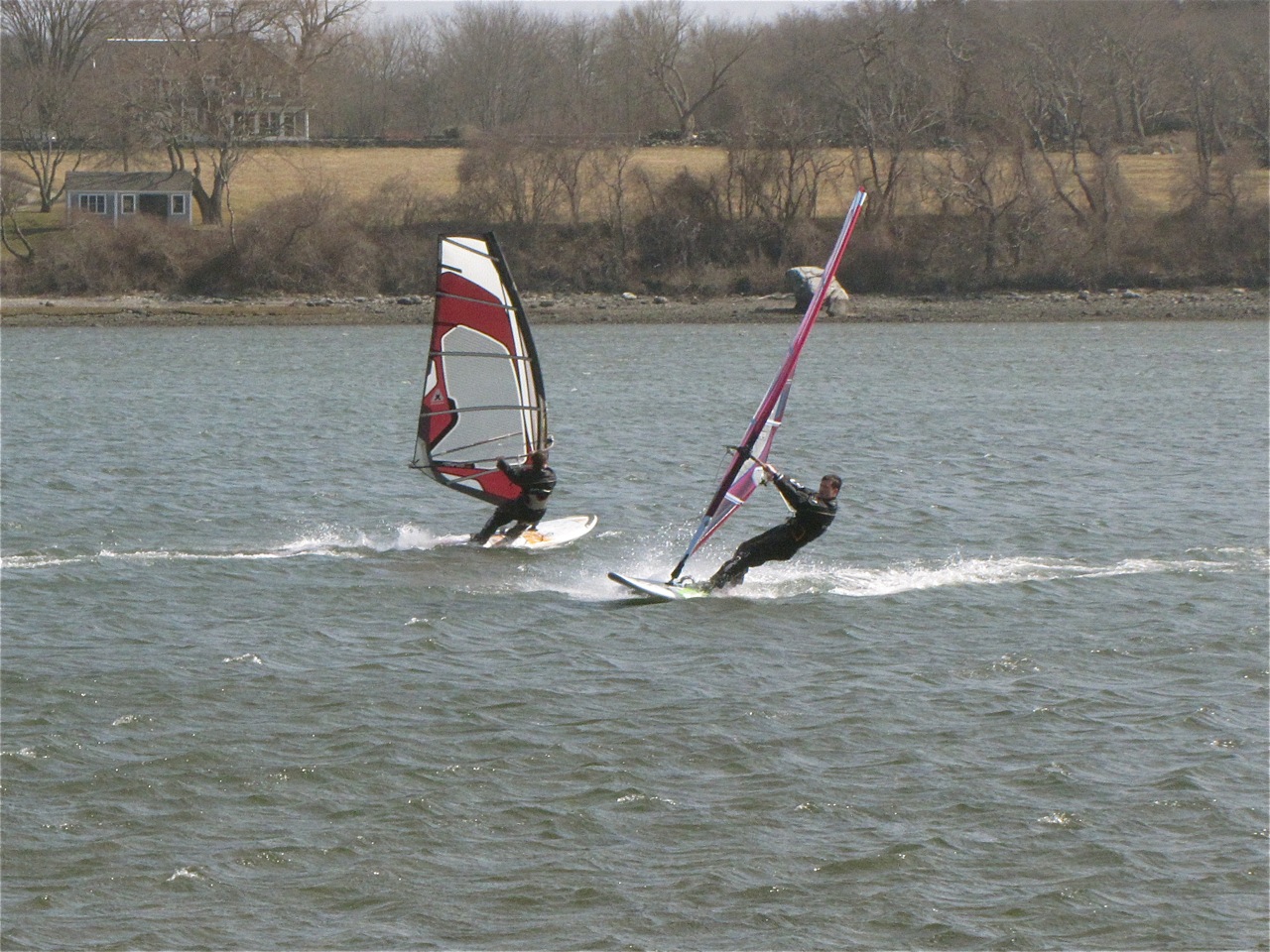
Nina and Chris
Graham

Chris

My lovely wife did not want me to show any pictures of her, because she felt that compared to Chris and Graham, she only did "boring" stuff. Well, she did use the two days to work on her jibes and duck jibes, and made a lot of progress in gusty conditions. GPS tracks are great to get an objective assessment of how good jibes were - and she did her best jibe ever that day. Here's the GPS track:
Her minimum speed of 10.6 knots in the jibe is very good; but even better is that she kept at least 67% of her entry speed during the entire jibe (usually, keeping 50% is pretty darn good). I filmed her a bit from the shore while I was taking a break:


Here's some GoPro HD footage, filmed with a Clew-View mount:


I just love the way she drops down and re-accelerates with a straight front leg. Her jibes are definitely better than mine now. On Wednesday, I still managed a couple of jibes with a faster minimum speed than Nina had, but only because I was going into the jibes with a lot more speed (being on a speed-oriented board with a cambered race sail, instead of a freestyle board with a waves sail as she was). But on Thursday, she easily beat my minimum speed several times. To add insult to injury, one of her fastest jibes was a cleanly planed-through duck jibe - her first. I can duck jibe, but I have yet to plane cleanly out of one...

It is pretty amazing to see the quite dramatic improvements in Nina's jibing in two days at Fogland. But one reason for these improvements is that Fogland Bay is simply a perfect training ground for jibing and freestyle. The water stayed flat, even when the wind gusted into the high 30 and low 40 mph ranges; runs are short, forcing you to jibe or try something else every minute or so; and the shallow water means you don't have to waste energy on waterstarts, or worry much about getting cold from falling often. It's also easier to come in and take breaks than at many other placing, since the distance from the shore to your car is about 20 feet.

So much for the interesting part of these two days. I was much more boring than anyone else, mostly going back and forth and trying to go fast. The one bright thing was that I got to try out my new Delta Freeride fin from Maui Ultra Fins. This fin has a radically different shape from most other fins:
It is only 18.9 cm long, and replaces a 29 cm regular weed fin, or a 32-34 cm standard fin. Here are my first impressions after 2 days of sailing it:

  • Easy to sail. Given the radically different shape, I had expected that some things would be quite different, but I did not have any noticable problems.
  • Fast. I got my second-best ever speed (30.38 knots) on this fin on the first day, and similar speeds the second day. That was despite less-than-perfect conditions: the water was so shallow that I had to sail in considerable chop, and the usual downwind speed strip on the tip of the island did not get enough wind to be fast.
  • Great to jibe. I planed through my second jibe, and might have planed through the first one if I had not jibed in a lull. On the 95 l board that I used, I'm pretty happy about every jibe I plane through, and I had a bunch of those on Wednesday, and a few on Thursday.
  • Gentle spinouts. Whenever I sail a fin first, I try to spin it out in different conditions (starting, full speed, jibing) to get a feel how much pressure the fin can take. Once planing, the Delta took about as much pressure as a 29-32 cm weed fin to spin out, which is quite good for the short depth. Spin outs were gentle, similar to weed fins, and recovery was pretty easy - much easier than with a 32 cm slalom fin.
  • No problems in chop. I have sailed a few fins that worked perfectly in flat water, but were uncontrollable in chop. The short length of the fin had me worried, so I did not venture out onto the river until the second day - but there was no need to worry. Spinouts were no problem whatsoever - the fin showed the forgiving characteristics of a much longer weed fin. But please read the update at the end of this post!
So the first impression of the fin is simply very good. With just minor adjustments to the board trim and my sailing style, it was easy to sail and fast. It seemed to be going upwind better than a large normal weed fin, but that's a guess, since I was fully powered most of the time, and did not do a head-to-head comparison. I do have a second MUF Delta fin to try, a Delta Slalom 212 (21 cm deep) for my 105 and 118 l slalom boards; I'll post here what I think about that one when I get to try it (maybe tomorrow :). But without any doubt, the Deltas from Maui Ultra Fins would be perfect for a shallow water place like Bonaire, since they can be about 30-50% shorter than other fins.
--
Update October 1, 2012: A few people have contacted me about the MUF Delta fin, so I need to add some more information. I did take both fins with me to a 3-week long trip to Hatteras (Avon) in the spring. I did have a lot of spinout problems with the fins in Hatteras chop, with both the 19 cm fin on my 95 l Hawk and with the 21 cm fin on my 105 l slalom board. I ended up not using the fins again after a couple of hours, since I had a lot more fun with regular weed fins. Perhaps the difference to my first test is that the chop on the river in Fogland tends to be much more orderly - it's really more swell than chop on most days. At least for me, the fin does seem to become problematic when the chop gets to big or chaotic.

Tuesday, February 28, 2012

Flat and flatter

We went windsurfing in Fogland yesterday and had a blast. We love Fogland because the little bay is protected by a sandbar and shallow, so you get nice flat water. Runs are only about 500 m (1/4 mile) long, but that's plenty for freestyle, which Nina did yesterday. I like Fogland to try new gear, and took my newest board out for the first time: Little Black Beauty, an Exocet SL66, 105 l, that I recently bought used. Here is a short boom cam video:


After spending most of my time recently on freestyle boards, it will take a couple of sessions to get used to the outboard foot straps, and to get everything dialed in. Still, the board was a lot of fun to sail, and made it really easy to plane through jibes. If you look closely at the video, you'll see plenty of things I do wrong (e.g. bending the front arm); but the board just ignored the driver mistakes and stayed fast. I planed through my second jibe, which I found quite amazing; I might have planed through the first one, except that the wind was a bit too holey on the other shore.

One reason I am posting the video is to compare how flat the water is in Fogland to how flat it is in one of the best long distance speed sailing spots, Lake George in Australia. In the past couple of months, several GPS Team Challenge teams from Australia reported 40-45 knot runs by multiple team members from this location, and many nautical mile averages in the high 30s to low 40s. That's just amazing - until you watch a video that shows just how flat the water there can be:

Well worth a long drive - it's not unusual for the Australian speed surfers to drive there 6 hours, sail for 5 hours, and drive back 6 hours. But really dedicated speed sailors like Spotty even drive 39 hours and 2560 km (1600 miles) for a few sessions!

Saturday, January 14, 2012

A comparison of speed strips

Too sore from getting beat up by 58 mph gusts yesterday, and too wimpy to sail today in near-freezing temperatures, I decided to look for reasons why no speedsurfer around here has gone much faster than 35 knots - while in Europe and Australia, hords of windsurfers are going faster than 40 and 45 knots all the time (and recently, a few have broken 50 knots).

For wannabes like myself, we can explain the low speeds by lack of skill and proper speed equipment. However, at least 3 of the guys on our Fogland Speed Surfer team are kick-ass windsurfers with extensive race and/or teaching and freestyle experience, and they all have gear that can easily go 45 knots. So what to blame then? Maybe the lack of proper speed spots in the area? 

I decided to have a closer look at our favorite spots, and compare them to West Kirby in England, where several speed surfers have broken 50 knots already this year. For the impatient readers, I'll start with a table that summarizes the results:
I'll briefly explain the different columns before I discuss each spot in detail.
Access describes how easy it is to get to the speed strip; ideally, we want to drive right up, carry our gear a few meters, and then race downwind at full speed.
Depth categorizes the water depth at and near the speed strip. Shallow water keeps the water surface smooth and fast, and can eliminate the problem of having to waterstart ridiculous large sails with huge mast sleeves full of water in very strong winds.
Tides show how sensitive a spot is to the tides; some spots are only fast at high tide, or may not be sailable at all at low tide.
Length is the length of the speed strip that can be sailed at the ideal angle. A 10-second run at 50 knots covers about 260 meters, but we need to add space to get up to speed and to stop.
Barrier relates to the jetty, sand bar, or similar obstruction that creates the perfectly smooth water for speed runs just behind it. 


Let's look at West Kirby first. The West Kirby speed strip is in a man-made "marine lake" that is 5 feet deep. The speed runs are made at a wall that rises about 4 feet above the water levels; the speed strip is about 620 m long, with extra room at the start to load up for Slingshots, and at the end to jibe. The low barrier wall can be walked, which makes it easy to walk the gear back to the start. The wind has a clear fetch for several miles across a bay before it hits the speed strip.

West Kirby is one of the fastest speed strips in Europe. Just 11 days ago, several speed surfers broke the 50 knot barrier there. So a speed strip length of 620 meters is definitely enough; for 40 knots, even 500 meter should be sufficient.
Next, let us look at Fogland bay in Tiverton, Rhode Island, the birthplace of the Fogland Speed Surfers. The entire bay is about 500 meters across, and quite shallow. Tides in Fogland are about 4 ft, and most days, the speed strip shown in the picture is sailable the entire time (at least with short speed fins). Only when tides drop below normal low does the ground start eating the fins of speed surfers who venture too close to shore.
The best wind direction for speed in Fogland is SW to WSW. There is a second speed strip going up along the shore that is about the same length. However, both strips suffer from gusty winds since the barrier here is higher (at least 5 feet at high tide) and more uneven than at West Kirby. A bigger problem for 10-second top speeds is that the runs are quite short - a 340 m run like indicated by the line in the picture above would require a very abrupt stop at the end. All this makes Fogland a great place to get started with speed surfing, or to go to when it's so windy that some extra safety becomes important - but breaking 40 knots there will be very hard, if not impossible.

The next spot to look at is Duxbury bay. Similar to Fogland, it is separated by a sand bar that is wide enough to include a road. Tides in Duxbury are about 9-12 feet, which affects windsurfing: at normal low tide, most areas in the bay are too shallow for windsurfing. Even in between tides, the lower water level increases the height of the barrier by about 5 feet, to a total of more than 10 feet, which disrupts the wind quite a bit. This is less of a problem closer to high tide, but then, the water about 50 feet from shore is more than 10 feet deep. This means that in theoretically ideal N to NNE wind directions, a lot of wind swell builds up, which kills top speed.
However, Duxbury is by far the best local spot for long distance speed (one hour, nautical mile, and total distance). In ENE to NE winds, runs are almost 5 km long. About 50 to 100 m from the shore, the effects of the barrier are negligible, and the water is still very smooth in light to medium winds. Doing 100 km here means going back and forth only about 11 times!


The next speed spot to look at is in Hyannis Port Harbor: the Kennedy Slicks. A stone jetty protects the harbor from the prevailing SW winds, and creates a 560 m long speed strip. The ideal wind direction would be W, but west winds come across land therefore are weak and gusty; the best wind direction that actually works is WSW. Tides are about 4 feet; at high tide, the top of the jetty is about 4 feet above the water level. That's almost perfect - but unfortunately, the first half of the jetty has a number of large holes, through which waves crash at high tide, creating small waves and limiting speed.
To sail at the fastest angles (120-135ยบ) in WSW winds, it is necessary to sail away from the wall. However, since the water in the harbor is pretty deep, the chop builds up very quickly, which again limits top speed. The Kennedy Slicks are a great place to play and practice, but reaching 40 knots here will be very hard, even if the tides and wind direction are perfect.

This brings us to the last local speed spot that we'll look at, the Egg Island Slicks. This spot is less than 2 miles from the Kennedy Slicks, on the other side of Kalmus Beach in Lewis Bay. While I have sailed the other local spots many times, I have sailed the Egg Island Slicks only once - and broke all my short-distance personal bests that day. Egg Island works best in SW winds, where it offers a 500 m long speed strip right next to a sand bar that is just barely above water at high tide. At the end of the sand bar, the chop increases gradually, enabling a controlled stop or turn. The wind tends to be a bit gusty at the start of the strip due to the "Great Island" below, so very small speed boards could be a problem. However, the setup allows a Slingshot approach from the right, and there is plenty of shallow water nearby to stand and rest.
The one drawback that Egg Island has is that it requires an approach over about 500-800 m of open water, which includes crossing a ferry lane. The waves and chop during the approach can be challenging; they were completely doable on a 30-35 mph day, but could present a real problem on a day like yesterday, where average were in the 40s and gusts in the 60s. Those are the days when real records are set...

Well, I think we can safely conclude that we cannot really blame the spots for our local low speeds. I think the problem may be more due to lack of "critical mass". With that, I don't mean body mass - Steve Thorp has shown that you do not need to be 6 ft tall or weigh 200+ pounds to break 50 knots. Rather, I mean number of speed surfers. Single speed surfer teams from Australia may get as many as 20 surfers onto the water on a given day, with 7 of them posting speeds near or above 40 knots; in the Netherlands, speed strips may see 100 windsurfers on a good day. Around here, I am happy if there are 3 of us on the water going for speed, and 5 makes a great day. But every time I get to sail with our better surfers, I learn a lot, and if we have good wind, I usually break a personal best or two.  In addition to the learning, bigger groups increase the stoke factor. For example, in surfing hot spots like Australia or the Netherlands, it is quite normal to take long boat rides, drive a few hundred miles, or even do 2-day trips by plane just to get to the right speed spot at the right time. Our little group may not be as big or as crazy about speed surfing yet, but we have seen a number of group sessions, new speed gear, and plenty of new personal bests in the last year - and I am sure 2012 will be even better.

Tuesday, September 6, 2011

Fogland Speed Surfers


It took us one year, but finally, the Fogland Speed Surfers were out in force this last weekend. We had typical Fogland summer winds - upper teen (mph) averages, gusts in the low to mid-20s, a bit more on Saturday and a bit less on Sunday.

For most of us, this was the first time sailing in Fogland after hurricane Irene. Afraid that we might get stuck on the road to the bay on the north side, almost everyone sailed the south side on Saturday. I was out on a 7.0 sail on my 118 l slalom board and the 110 l Skate; Nina was on her 100 l Skate and a 5.7; most other sailors were out on 6-7 m sails, nicely powered most of the day. Dani was nice enough to let me try his new iSonic 90 for a few runs, and I increased my top speed for the day within a few minutes on the board by 2 knots. The board jibed amazingly well, too - I wish I had one!

Of the Fogland Speed Surfers I saw on Saturday, only Cesar decided to drive to the bay. With his jeep, he did not have to worry, but mostly, he just wanted the flat and shallow water for speed runs. That worked for him - he got the fastest 2 and 5 x 10 second speeds of the day on his iSonic 122. At the end of the day, he stopped by again and assured us that the road was in good enough shape, so the next 2 days, most of us sailed the bay again.

Sunday and Labor Day has a similar SSW-SW setup, but the wind was a couple of miles lighter and a bit gustier. I started out with my 8.5 V8 sail on Sunday and a Makani 36 cm slalom fin. The combo worked great on the first runs in the flat water on the bay, although the fin was a bit small for the sail. That almost became a problem when I went out on the river, and the wind picked up at the same time - can you say "frequent spinout"? But before I could sail back to change fins, I heard a loud "boom" from my boom. I thought that a clamp at the end had opened up, even though I had taped it, and schlogged slowly back to the shore. While adjusting things there, the boom boomed again - this time completely breaking apart about 20 cm from the front. That meant a 60 minute walk back along the shore, followed by some paddling and a tow from Cesar (thanks again!). The rest of the day, I was a bit underpowered on my 7.0.

Conditions on Monday were similar, with less sun and just a tad more wind. Interestingly, I got my top speeds on Sunday and Monday on the river, not in the bay. The bay has smoother water, but runs are only about 500 m long, often with a wind drop in the middle - not the best thing if you're just marginally powered. Going out onto the river gives mile-long runs, and the swell on the river is often very smooth, with nice, long rollers and very little cross chop. Furthermore, the wave direction varies about along the run, so there are typically longer stretches that allow decent downwind angles for speed. I'm pretty happy with the 26 knots I got on my 118 l Warp on days there the maximum wind meter reading was 23 mph (in gusts). The 6 weeks in Maui definitely paid off here: last year, I always thought of the river chop as challenging; but now, it seems more like a flat speed strip to me.

The forecast for Monday had been quite good, so Nina had brought the 77 l Goya One along. She actually got planing on it with a 5.3, but just barely so. After switching to her 100 l Skate, she worked on Vulcans the whole day. She's definitely ready for the upcoming ABK camp in Hyannis!

Here's a short video from the last two days that shows quite nicely how flat the water in the bay is:


BTW, the Fogland Speed Surfers is an open group and welcomes new members. If you like sailing fast and have a GPS, join us! If you have any questions, a good way of contacting the team is through the "Fogland Windsurfers" group on Facebook.

Saturday, March 5, 2011

Fogland, south side


One of my favorite windsurf places is Fogland in Tiverton, RI. Up until today, I have always sailed on the north side. The water in the little bay area is shallow, between knee and shoulder deep (depending on tides and exact location). In S-SW winds that prevail in spring and summer, the water in the bay is very flat - flatter than Bonaire. Since the bay is only about 500 m (1/4 mile) wide, you get to practice jibing a lot. On occasion, I have ventured past the little island into the river, but when starting on the north side, the little island can cast quite a bit of a wind shadow.

When deciding where to go windsurfing today, I picked Fogland, since it's a safe place to surf when you are alone, and I could not get anyone else to commit to a place before I left this morning (my lovely wife is visiting her family). However, the tide was really low in the early afternoon, and I was in the mood for longer runs, so I wanted to try the south side. The runs there are more than a mile long - unfortunately for GPS sailing, a bit shorter than a nautical mile.

When I got to Fogland, the winds looked so low that I considered rigging small and practicing light wind freestyle. However, with air temps around 5 C and water temps a bit lower, I was not really motivated. After a few minutes, another windsurfer (Dave) pulled up, and while we were chatting, the wind picked up. We rigged big (Dave 6.5, I 7.0), and soon were out on the water. The wind was gusting at first, and Dave, who sailed for the first time since November, struggled a bit, although his jibes were dry and did not look bad to me.

Following his example, I waded out a bit to the point where the wind line was, and soon was planing. After a few adjustments, I started having some serious fun. The water is pretty flat on the launch site, but as you get further out into the river, small swell forms and becomes bigger and bigger as you approach the other shore. Even though the winds were not very strong (low to mid 20s), the swell near the far end was big enough for some little wave rides and jumps. Fun! At the same time, the swell was nicely organized so that staying on the water when you did not want to jump was really easy - not like the voodoo chop in Kalmus on a windy day!

I sailed a bit more than 2 hours, with a couple of small breaks to drink some hot tea and change gloves. The wind got steadier, and I nailed most of my jibes thanks to help from the swell on the far side, and nice flat water on the inside. I really like windsurfing on the south side of Fogland - you can pick the level of swell you want by picking where you jibe, or do long runs and enjoy the gradual change.

As much fun as the south side is, the flat water on the north side is definitely better for top GPS speeds. Wind meter readings show gusts above 30 miles today, but my top speed was only 27 mph. I was in my Fanatic Skate 110, which is a bit slower than the my smaller boards, but I have hit more then 30 mph on it several times on the north side in similar conditions. However, for nautical mile runs, one hour averages, and total distance, the long runs on the south side are a definitive advantage. Indeed, I got ok reads in these three categories today - if only one of the other Fogland Speedsurfers had been there, too! Well, it's getting warmer now, so we'll hopefully enjoy their company before the end of the month.

Wednesday, March 2, 2011

Fast Fogland

Spring is close, and the winds are starting to change - south winds now are often better than the north winds that dominate fall and winter here. We scored a couple of nice S and SW sessions in Fogland today and two days ago.

The Monday session started a bit crazy. The weather forecast called for "showers", which did not sound too bad. But when we arrived in Tiverton, it had been raining cats & dogs for an hour straight, and there was no indication that the rain would end any time soon. We stopped at the Coastal Roasters for a coffee and cookies, and then drove to Fogland. The rain had created a little lake at the entrance that looked like it was about 4-6 inches deep - or so I hoped. Well, it was not much deeper, my little Civic made it through just fine, pulling out trailer. Winds were very much up and down, but the rain was constant. With temperatures just a few degrees above freezing, we seriously considered just driving back home. But my iPhone and the NWS radar maps saved us - looking at a few successive maps, it became apparent that the worst of the rain had already passed us. Indeed, the rain stopped 20 minutes later, the wind became more stable, and we decided to give it a go. The goal was to get some speed runs, so that the Fogland Speedsurfers would not end the month of February at the bottom of the GPS Team Challenge Ranking.

Nina went out on her 76 l wave board with a 4.2, I used my 82 l Super-X and a 5.5. Winds were rather gusty and dropped a bit after a while, so we were a bit underpowered most of the time, but fully powered in the gusts. Nina set a new 2-second speed best, and I got some ok runs in, too, that moved us out of the last place in 2 and 5x10 second ratings. However, the short runs and gusty winds did not allow us to get good long-distance speeds or total distance, so we remained in last place on the team challenge.

Well, today was a new month, early morning wind readings were in the mid-20s, and the forecast predicted even more wind around noon. It was also sunny, so we just had to go back to Fogland. On the way, we saw more white caps on the river than I had ever seen before, and the meter readings showed gusts in the 40s - nice! We rigged our smallest sails (3.7 and 4.2), and went out on the same boards as two days before. It was definitely windier! Alas, it was also low tide, which shortened runs even more, and created some unwanted ground contact a few times. After an hour, the wind dropped a bit, and we were underpowered again - so I rigged my KA Koncept 5.8, and Nina switched to the 4.2. She was nicely powered then, and so was I, with gusts still in the upper 30s.

I played around with a few things today. The first one was a switch from a 28 cm slalom fin to a 26 cm Tangent Dynamics Reaper weed fin (while I was still sailing the 4.2). That gave me an immediate speed boost, and a more controllable ride - nice. Indeed, the small Reaper almost looks like a modern speed fin with a lot of rake. When I switched to the 5.8 later, the fin was a bit small to go upwind well; but the short runs (400-450 m) did not help, either.

I rigged the 5.8 m sail when the wind had gone down a bit. Of course, as soon as it was ready, the wind came back as strong as it had been when the 4.2 had been big enough. This was an interesting test - how would the cambered speed sail handle the gusts? Not surprisingly, it did great, and handled gusts close to 40 without any problems. My top speeds started to go above 50 kmh in almost every run, which is pretty fast for me. The wind was definitely strong enough for faster runs, at least in some gusts. I could blame my limited speed on the short runs or the bad timing of the gusts, but it probably was mainly just me not putting the pedal to the metal.

But on the other hand, this was my third-fastest session even (based 5 x 10 second averages), and my fastest session ever in Fogland - so I'm really not unhappy. I got a nice jibe in, too, where I was standing on the board without power in the sail and saying to myself "I can't believe the board kept this much speed!". Unfortunately, all my good jibes today were at the end of long downwind runs into low-wind regions, so I did not get a good alpha. Nina beat me on the alpha today, and by quite a margin, too!


Nina's jibes are definitely looking ever-better. She still has not planed through one yet, but she is getting close, and the GPS readings confirm this. She made most of her jibes dry today, too, and overall looked great on the water. Her top speed readings were very close to her personal bests, even though she did not do any speed runs until the wind had gone down a lot towards the end of the session.

Air temperatures today were about 5 C (41 F), and water temps probably a few degrees lower. We were nice and warm the entire time; it probably helped that we mostly stayed where we could stand, but we also did have a few falls where we could not touch ground. The dry suits and 7 mm boots are definitely great; for hands and heads, open-palm or open-finger mitts and gloves and light neoprene hoods were good enough. Just to stay really warm, I also tried my NRS Reactor gloves again today, and loved them. They have pre-bent fingers which makes holding onto the boom pretty easy, with minimal lower-arm fatigue, and were plenty warm today.

Today was just a great day, and for once, the wind forecast was right on target. Looking at the iWindsurf sensors, Fogland had higher average winds and gusts today than West Dennis, which will happen more often as it gets warmer. Winds in West Dennis were steadier, but again, as it gets warmer, southerly winds in Fogland will get steadier, too. Hopefully, we'll see more of the Fogland windsurfers on the water soon!