Showing posts with label loop. Show all posts

Saturday, August 25, 2018

Punch the Giant's Nose

This post is not about boxing or football, sorry. It's about the loop. I like simple explanations, especially when thinking about a move that takes only a second. How many things can you think about in a second? For me, the answer is "one" - maybe two on a good day.

Some old loop instructions were simple: "Jump high and sheet in!". That actually did work for some people. But for many others, the advice resulted in "killer loop" attempts that broke gear and bones. You'll probably have a hard time finding a professional instructor who uses this advice. Broken gear and bodies are not good business.

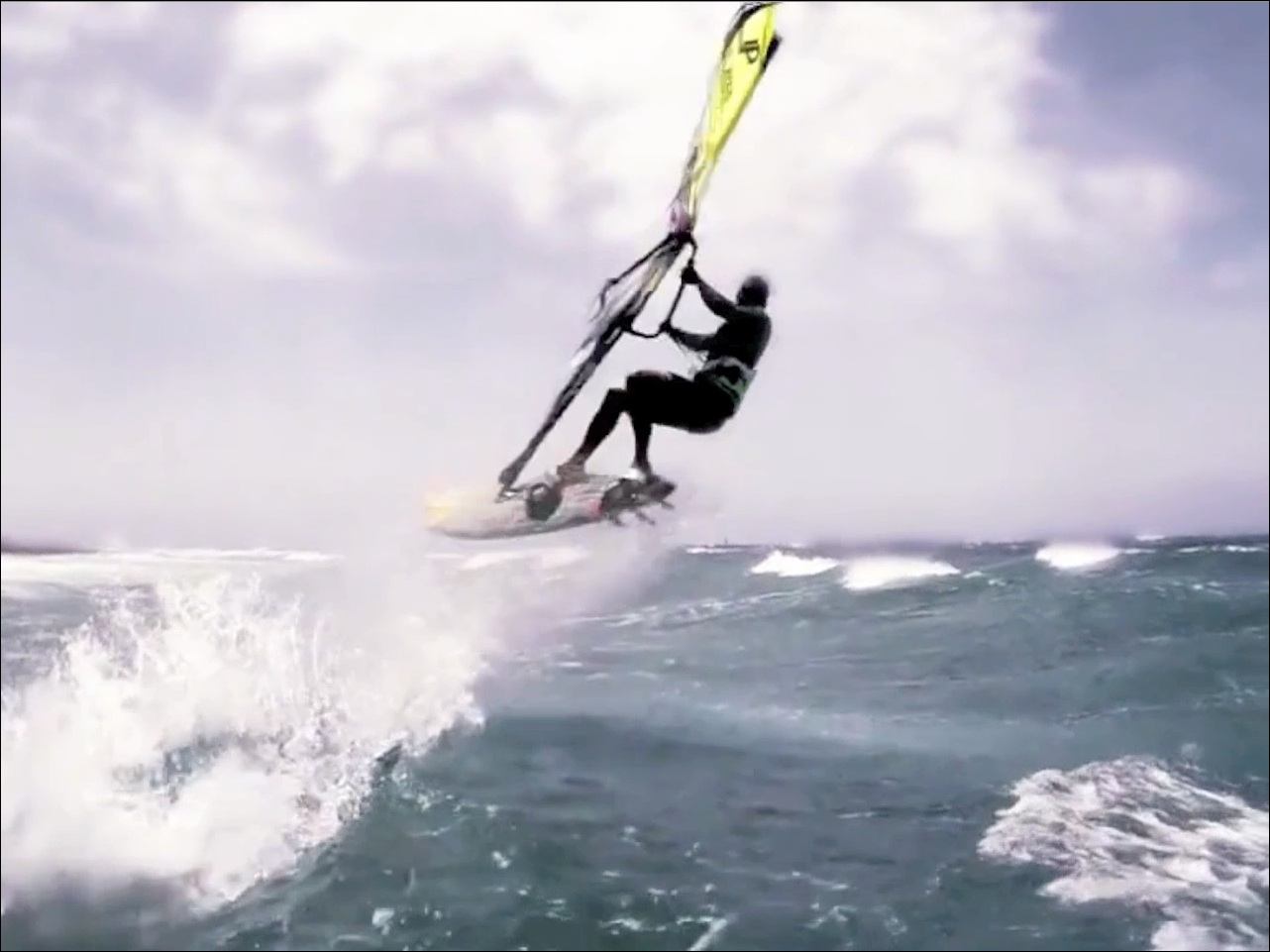
I've been looking at loop videos a lot recently, and noticed a few things. Let's start with a picture:
This is from a Josep Pons video that I blogged about in the past. He is setting up for the loop. Note that his body is over the board, and both arms are bent, with the elbows at roughly a 90 degree angle.

Now check the next picture:
Josep is starting to take off, but the board has not yet left the water completely. The mast has moved towards the windward-forward side, and his front arm is fully extended. The back arm is still bent, but the hand is over his head.

Mr. Pons has some of the most beautiful loops in windsurfing. Lots of PWA pros line up to get lessons from him, often to work on double loops. Imitating him seems like a good idea!

The movement of the front arm is punch-like. Just imagine a giant standing on the front-right side, and Josep trying to punch his nose! The back hand also goes up; with the giant there, I guess he's protecting his head from counter punches.

The bent front arm in the first picture means that the sail is partially de-powered: bending the front arm sheets out, the same way as extending the back arm would. In the loop, the sail must be partly sheeted out at the beginning, so that the mast can be moved to forward-windward (where it is in the second picture).

Punching up helps to lift the nose of the board for lift-off. Interestingly, extending the front arm to punch the giant's nose also exposes more of the sail to the wind - it effectively sheets in. That starts to turn the nose of the board downwind, which in turn exposes even more of the sail to the wind - I call this "automatic sheet in".  This can be clearly seen if you compare picture 2 to the next picture, where the board has just left the water:
We've just punched a giant in the nose. That made the giant angry! I think it's a really good idea to make ourselves really small now, so the giant has a smaller target:
By curling up into a ball, we can rotate faster. If you've ever tried a somersault, you know that! In the process, we also pull up with the back foot, which keeps the tail of the board from going back down into the water prematurely.

If you're learning the loop and managed to first punch the giant's nose like Josep, and then curl up into a ball, you're well on the way to at least landing on your back, hopefully in a position to water start, so I won't go into what comes next - I think that's comparatively easy, if you managed to get into the position shown in the last picture above.

So, here's the really simple loop instruction:

  1. Before takeoff, get your body over the board. Sheet out by bending your front arm.
  2. As you go up the wave, punch the giant's nose. Just remember that the giant is standing on the windward-forward side of your board, and not on the nose of your board!
  3. Once in the air, pull up with the back leg and make yourself small. Enjoy the ride!
As I am writing this, I can't help but think back at the one time I actually fought a giant. Maybe "fought" is an overstatement - it was just point sparring at a Kempo Karate tournament. Maybe he was not really a giant, but he was at least a head taller than I was. The fight was over quickly. No, I did not manage to punch his nose - I had never before sparred with anyone who was a lot taller than I am, so I really had no clue. But the giant in the loop is imaginary, so he should be easier to hit, right? I won't say he does not hit back, though - I have had a few hard backslaps in earlier loop tries. Maybe it helps if I hit harder :-).

Friday, November 25, 2016

New Loop Instruction Video

Here's a new loop instruction video:

It's very similar to most of what Andy Brandt teaches, but adds a few explanations that make a lot of sense. I especially like his explanation of "tall - small - tall":

  • get tall first, lifting up on the boom, to get the nose up
  • once the board is on the air, get small by pulling yourself up on the boom, and pulling the back leg up, to rotate
  • finally, get tall again to stop the rotation before the landing
Unfortunately, one critical piece of advice is missing in this video: how to grow a pair and go for it ...

Monday, July 27, 2015

Loops In Fuerte and Jeri

If you watched the videos from the PWA freestyle competition over the past few days, you may have noticed how often the pros did a forward loop. It seemed like every pro threw at least one forward per heat. This is somewhat surprising to me, considering that everyone claims the forward loop is so easy! A few of the pros spiced the loop up a bit - Tonky Frans did some of his trademark Bonkas (a loop into Flaka combo); crazy (as in: crazy good) Balz Müller did a one-handed rail grab loop. But the vast majority of loops were "simple" plaining loops.

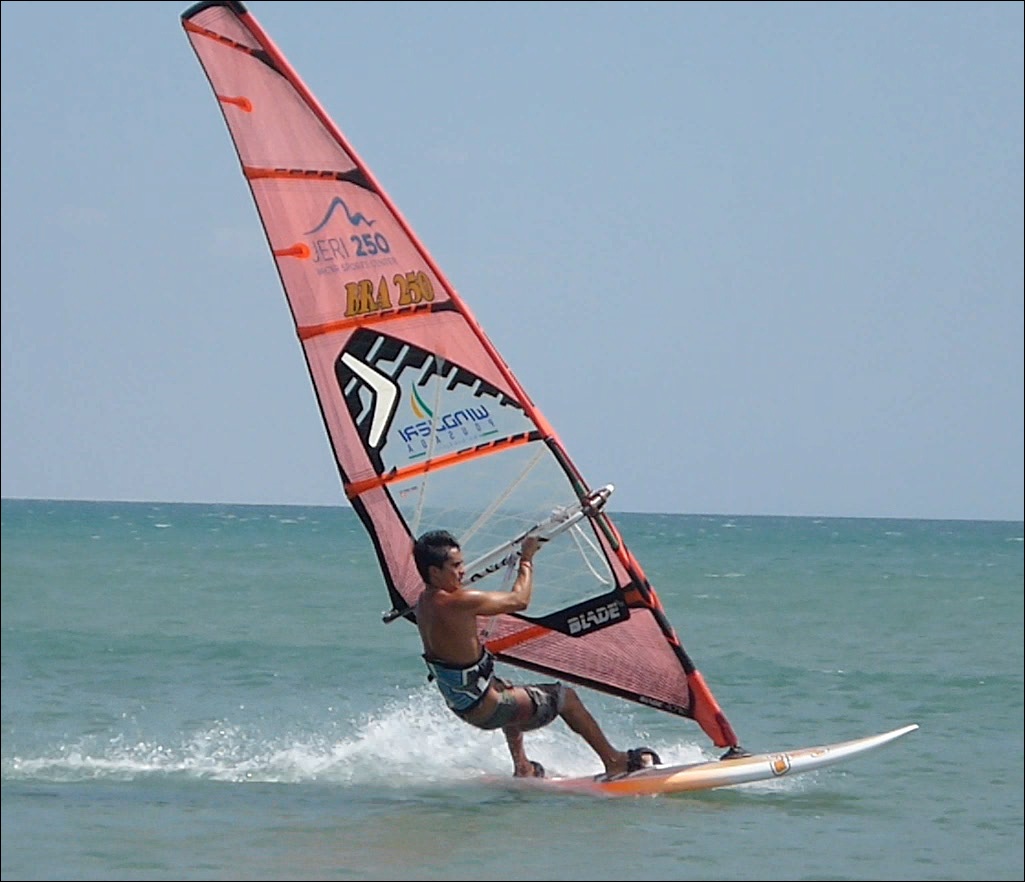
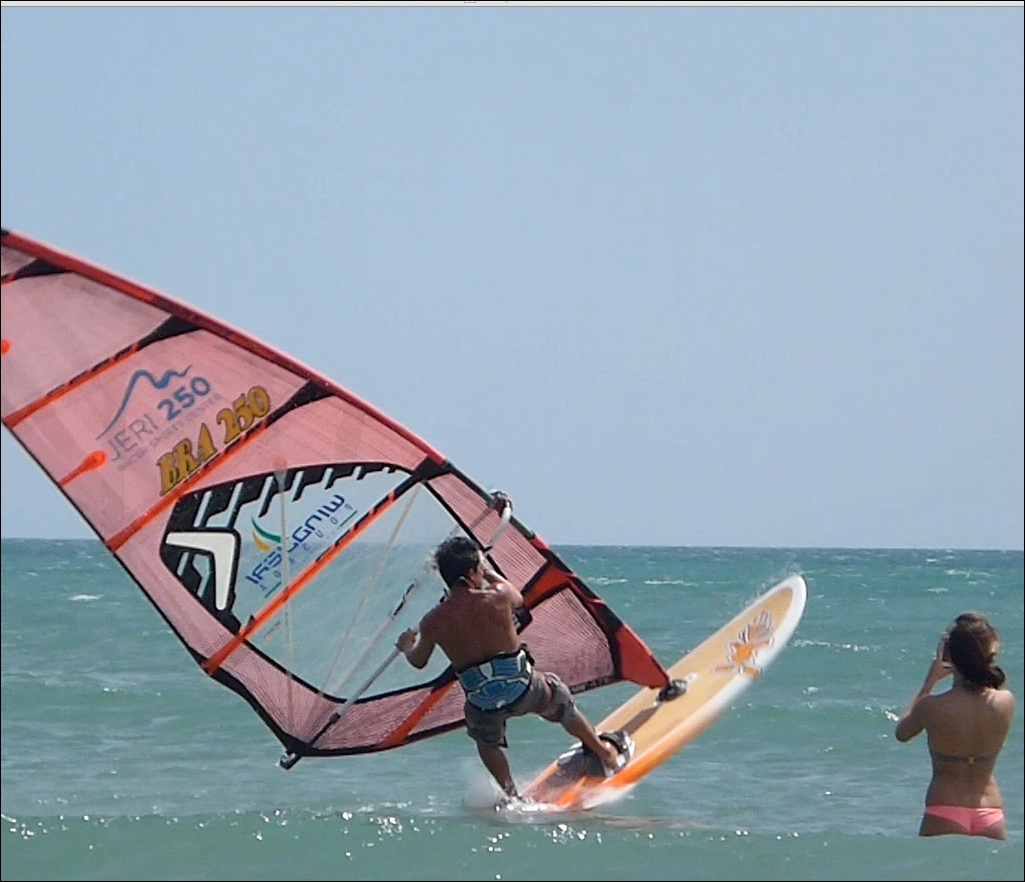
During our Jeri trip, one of the highlights were the freestylers that were out every day. We saw plenty of loops, including some of the most beautiful ones I have ever seen. Here is an example that Nina filmed while standing in knee-deep water:

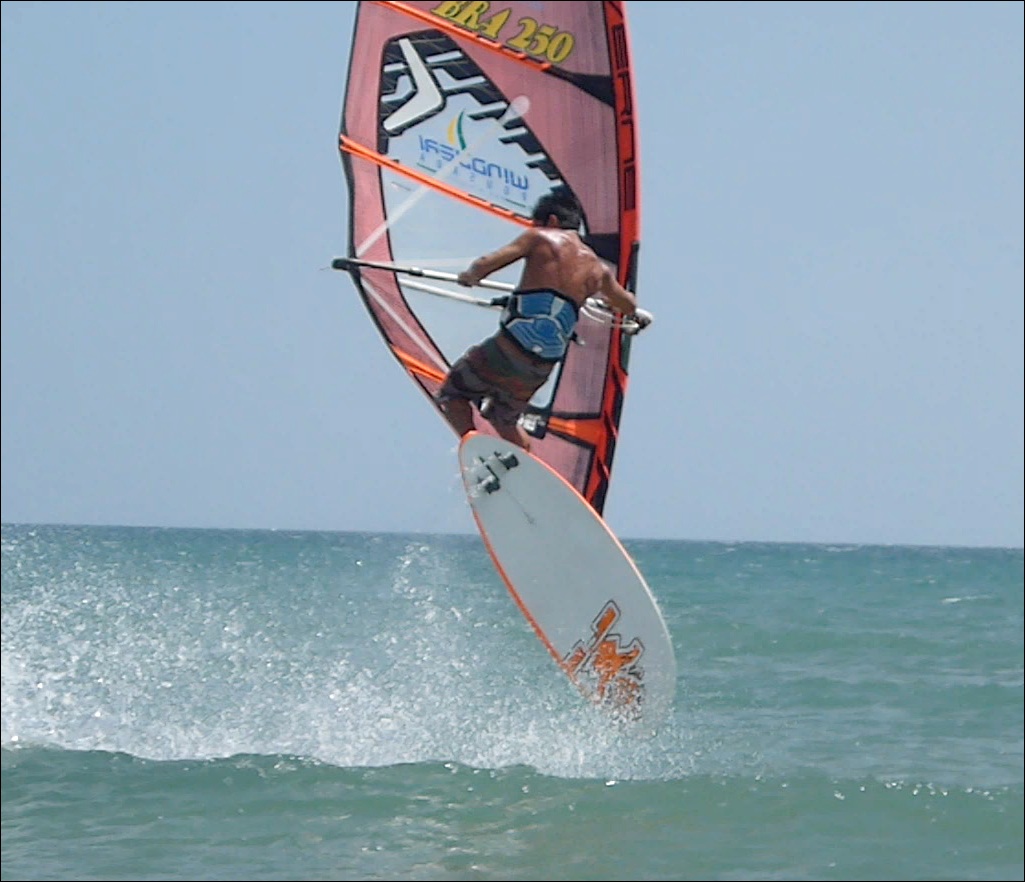
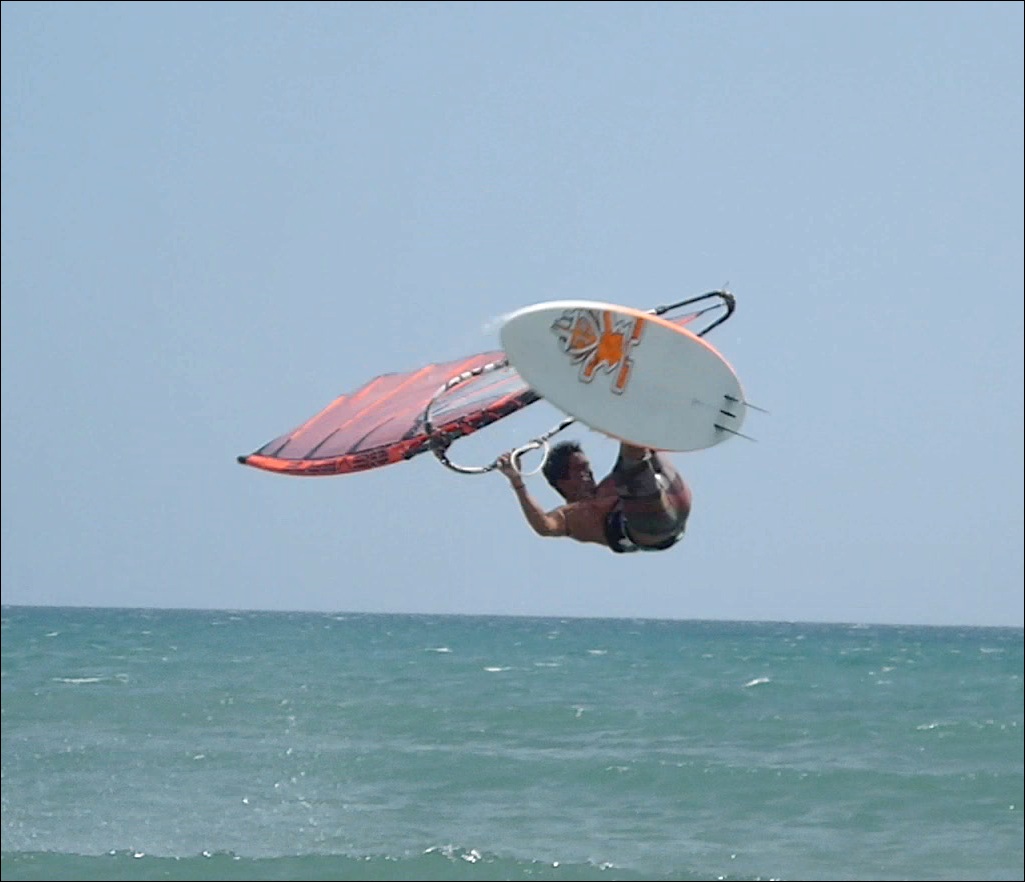
A thing of beauty indeed. For all those working on learning the loop, here are a few screen shots from the movie, with a few notes:
Not a lot of power here

The back hand moved far back on the boom

Compressing before take off

Front arm extending, moving the sail forward-windward

Fully extended front arm and back leg; fin is still in the water

Fin leaves the water. Both arms long, no sheeting in. Nose starts turning downwind

Starting to pull himself up over the boom

Upper body above boom, nose getting pushed down

Fully up-down; both arms are bent, still not sheeting in - but the sail is getting power now

Back leg fully bent, front leg extended


Almost there - starting to extend arms to push sail up and stop the rotation


Soft, controlled landing

Planing out
The windsurfer in the movie and pictures is Edvan Souza (BRA250), a former PWA competitor who now runs Jeri 250, where you can rent gear and take lessons. Here are a couple of more videos - first a close by loop followed by a Shaka:


Another great planing loop, with a Flaka before and a Spock 540 after:

Saturday, January 3, 2015

The Loop Takeoff

I had a chance to study Martin's loop try videos, and want to share my theories with you. Just to be clear: I am talking about learning to do a mostly horizontal spin loop in moderate chop or small waves.

A lesson I learned from working on jibes is that the problems you see are often caused by doing something wrong much earlier in the move. I think the same thing applies here. I will also assume that Martin's problems are similar to problems I have had when trying to loop, and to problems I have seen other ABK campers have. Let me start with a picture from an ABK camp in Bonaire in 2011:
This is the takeoff for one of my first loop tries. I got the nose of the board up nicely, which is good. But you can see that my body is angled very far back, which is bad. I never got the nose to go down and the tail to go up; instead, the board just dropped back onto the water tail-first, and I got catapulted around a bit. Now let's look at one of Marty'ns tries from the video I posted yesterday:
Takeoff #6
His body position is a little better than mine, but also looks wrong. The next picture shows how this try (#6 in the video) ended:
Landing #6

The board landed tail-first, and Marty fell to the inside. Now let's look at his next try. The takeoff:
Takeoff #7
Do you notice the subtle differences? We'll come back to that, but let's first check out the landing:
Landing #7
This time, the front half of the board hits the water first, and Martin's body is a bit more to the right side, closer to where it should be.

Now look back at the takeoff pictures. In the first picture, Martin's front leg is straight; in the second picture, his front leg is bent a little bit. This allows his body to be a bit more upright over the board.

Now let's look at Jerry's takeoff posture:
Jerry looping
Jerry's front leg is bent quite a bit, and his back leg is straight. That allows his body to be much more over the board. His upper body is also straight over his back leg, not bent forward like Marty's. Looking at the other "great loop" example in the video, we can see the same thing:
Joseph Pons demonstrating loop takeoff posture
Again, the back leg is straight, the front leg is bent, and the body is mostly over the board.

Once the board leaves the water, the legs should do two things: the back leg is pulled in to pull the tail up; and the front leg extends to push the nose down and downwind. It's easy to see how this would work in Joseph's and Jerry's example. But in Martin's takeoff #6, his front leg is already extended, and his back leg is already bent a bit; the only think he could do would be bending his back leg more, which would not be enough to level the board.

Amuse me for a minute, and assume that the analysis above is correct. To fix the problem, we need to have Martin bent his front leg more at takeoff, and keep the back leg extended. That will keep his body more over the board, making it easier to move the sail to windward - forward. Once the nose turns downwind, causing the sail to load up, his body will also be in a much better position to get thrown around, giving him a chance to complete his first loop.

The goal is clear - how do we get there? Our challenge is to over-write "bad" muscle memories from many, many tries.  But fortunately, Martin already has the necessary skills - he can do tail grab jumps, and he can pop the board in flat water. So here's the prescription:
  1. Do the "wheelie" crash from the ABK loop lesson (that's stopping the board by opening the sail and stomping on the tail; slalom sailors often stop this way). Make sure the sail is open, and try to stay as upright over the board as possible; the front leg should be bent much more than the back leg.
  2. Practice pops in flat sections. Think of a variation of Andy Brandt's "independent arms" - we're going for independent legs (and, of course, being over the board). About 20 should do.
  3. Try loops. Think of it as a trail grab pop, but instead of letting go with the back hand to grab the tail, move the rig to windward, look back, and hold on!
I changed the prescription a day after the initial post - I took out tail grab jumps, and instead added the "wheelie" exercise that Andy Brandt has as a part of the ABK lecture. The tail grab jump may help to learn the loop (Jem Hall thinks so), but in all jumps, there's a strong tendency to lean the body back to counter-act sail pressure. That's counter-productive in a loop, where we want give into the sail pressure to be thrown around. In contrast, I think the "wheelie stop" crash exercise may be a good way to learn to get the nose of the board up by bending the front leg. I'm not 100% sure of this, but I plan to try it out soon!

Visualization can also be helpful, so here's a video with a slow-motion "starboard" version of Josep Pons' loop:


---
Shortly after I posted the video about Martin's loop tries, his friend Nikita sent him an email with tips. Nikita actually knows how to loop (and Vulcan, Grubby, Spock, etc.), so I thought I'd share his comments here (I added the highlighting):
"Now, Peter says that there is a mystery as to why you can't loop. Watching the video, the culprit seems pretty clear to me - you stay way back when you jump! You have to move both you and the rig much more forward as you are going up the ramp. As it is, you are not even catapulting. If you are not catapulting, you won't loop. You seem to be trying to do it sort of safely, but you really have to be going for some serious catapults if you want to get there.
When we were all in Hawaii, I was going farther than you in my loop attempts, but was still not getting close. Sergei told me that I was jumping my normal jumps and THEN trying to move the rig forward in the air - wasn't working. Once I started leaning forward going into the jump, then my rotation really improved.
Obviously, if you lean forward as you are going up, there is no way to land safely, other than looping. You will 100% catapult. This is a very uncomfortable feeling, but the only way of doing it. You've got to be more aggressive and be prepared for those bumps and bruises.
It's actually very similar with all the other moves: Vulcan, Spock, Grubby, Flaka, etc etc. You have to jump way forward as you are taking off. Basically overcome your fear of the catapult and forgo any thought of landing a normal jump. That's probably why Andy has been telling Boris to not even learn to jump and go straight for the Vulcan - knowing how to jump properly keeps you too far back. I don't think I agree with his approach (jumping is fun in itself!), but the issue is clear - normal jumps and freestyle jumps are very very different, even on takeoff."

Friday, January 2, 2015

Loop Try Videos

Below is a short video with some of Martin's loop tries. Keep in mind that this is footage from sailing in Hyannis on New Years Day 2015. Air temperatures just above freezing kept even some brave souls that do sail through the winter off the water. I took the cold as an excuse to not try anything. Martin tried loops - one thing where you are guaranteed to get wet:

Here are just some brief thought about Martin's loop tries:
  • He tries to move the board around with his feet - it looks more like an old-school jump jibe than a loop. He's gotten pretty good at turning the board this way, sometimes getting it to turn 180 degrees.
  • The nose-tail exchange never happens - the nose always remains above the tail.
  • In several tries, the sail powers up after the board is in the water again. That's something I have seen many times when ABK campers tried loops. It often happened to me, too.
For comparison, I added some footage from Jerry Evans, who throws beautiful loops almost every time I get to sail with him. Jerry's loops are often very vertical, end-over-end. That is not the best loop to learn, unless you got great waves and are really comfortable with high jumps. However, the technique as Jerry shows it is very similar to a more horizontal loop. The big difference is where you move the sail: more to the nose of the board, and it's vertical; more to windward, and it's horizontal. But Jerry's loop was also filmed with a Clew-View mounted GoPro (big surprise - Jerry makes the Clew-Views!). I also added a couple of loops from Joseph Pons' video which are more horizontal for comparison. He really shows the rig movement to windward very nicely.

The loop try video did not hold surprises - this is what Martin's loop tries have looked like for a while now. We made the video mostly so he can also see what his tries look like. I think he has all the technical elements he need - he can jump and pop well enough; he can pull his back foot up and stretch the front leg to get the nose down; he can move the rig to windward; and he is starting to get good at turning the board with mast foot pressure, even when the board is back in the water (where that is a lot harder than in the air!). He "just" needs to put the pieces together, and unlearn some bad habits (the jump jibe-like board turn). The only thing I did not see in the video was exposing the underside of the board to the wind - but I have seen him do that at other times.

So, Martin, get around already, will you? Otherwise, I might grow a pair and loop before you!

Tuesday, December 30, 2014

Beautiful Loops

This is one of the best windsurf videos I have seen in a while:


Great scenes, great loops. I love the forwards he throws - they are all different. But they are all very horizontal. At 0:58, he illustrates several concepts Andy Brandt teaches nicely, including big-small-big; sheet up; and pull yourself up. In the double forward at 1:40, he completes his first loop while going up. Cool. In his stalled high forwards, you can really see the rig movement to windward; the harness mount perspective at 1:52 is great.

His back loops are cool, too, although he seems to have a bit a problem keeping hands and feet on the gear. One might think he set out to illustrate what Tonky Frans was talking about when he pointed out the similarities between back and front loops recently.

Tuesday, December 2, 2014

Tonky's Loop Advice

The forward loop is the dream of many windsurfers. For some young hot-shots, it's easy. They just "jump high, sheet in, look back", and get around. But unless you are young and heal fast, I do not recommend this approach. At the first loop lecture I heard, three guys had tried this; all three got thrown onto their gear and got hurt. In at least one case, it was a season-ending injury.

For the cautious rest of us, there is another approach to learning the loop. It's based on Remko de Weerd's "Loop in 4 steps" video, and has since been adapted by AKB. I have seen dozens of windsurfers getting started on the loop this way, and nobody got hurt; a bunch of guys actually did learn to loop this way. Not me, though. Every time wind and waves are right, I chicken out. I'm not the only one, either - I know several windsurfers who have been working on loops for years, without ever getting one.

So when I read what Tonky Frans had to say about the loop on thewavehobbit, I got excited. Many things Tonky suggests are quite similar to what others say, but there are a few things where he differs. Here's a very brief version of Tonky's advice:
  1. Pop the board at a slight upwind angle with a mostly depowered sail. Your body is centered over the board.
  2. Move the rig towards the wind (the mast to windward).
  3. Pull your back leg up to your butt.
  4. Keep the back hand close to your body, and the front arm relatively extended.
  5. As the nose of the board turns downwind, your sail will automatically power up. Speed up the rotation by extending your front leg (but keep the back leg and back arm bent).
  6. Keep this position as you get thrown around.
There's some more advice about the ending, but if you make it to step 6, the rest is easy. It's getting to this point that hard. Let's look at how Tonky's advice helps:

Pop the board at a slight upwind angle.
This is new to me (at least for flatwater loops). The more common advice is to go downwind, or at most at a beam reach. Tonky states that a slight upwind angle helps to get more height, and to reduce forward speed. That makes perfect sense to me. I like the idea of reducing forward speed, since falling back into the water after an upwind jump with minimal speed is definitely not scary. I can do that.

Move the rig towards the wind
This is a common suggestion for loops, seen in Remko's video and heard from the ABK folks. The idea is that the sideways pressure from the mast foot will move the nose of the board downwind. Since everything will be in the air, not a lot of pressure is needed to get things moving.
However, this advice is quite different from "jump high and sheet in". In it's purest form, this will have the mast vertical, and start an end-over-end rotation. That's fine if you're jumping full-speed over a big wave, and end up 15 feet above the water. Anything smaller, chances are that things go wrong big time. Maybe your nose will land on the water, and you and/or your rig will be thrown violently onto your board. Or maybe your mast will hit the water, and you'll break it or get stuck upside down.

Keep the back hand close to your body.
Tonky says "engaging the power is just keeping the back hand right close to your body". That's quite different from "sheet in hard", a very common loop advice. How could Tonky's advice possibly work? He does point out that not having enough power in the sail can cause under-rotation (a common problem for loop learners). 
The important thing is that moving the rig to windward will cause the nose of the board to turn downwind. Even if the arms don't move at all, this will cause the rig to power up - an "automatic sheet-in", so to say. Once the sail starts to power up, the nose will turn downward quicker, and the power in the sail will increase rapidly, until you get through around. If you extend your back arm at this point, that will take power out of the sail, and slow the rotation down - bad idea! 

If you're thinking about looping, or about teaching someone else to loop, please make sure to read the original article carefully. The different parts of advice go together - mixing parts of it with other commonly heard advice could have very bad consequences.  For example, if you do want to try a loop by jumping over big waves and sheeting in hard, you definitely should try this from a downwind takeoff to reduce the chances of falling onto your gear! 

But for me, Tonky's explanation makes perfect sense. I particularly like how he explains how various elements reduce the risks. For example, staying over the back of the board keeps you from getting thrown into your gear (assuming the other parts of your setup let you rotate horizontally); or how staying below the sail means that over-rotating is not something to be afraid of.

Friday, June 17, 2011

Josh Angulo's loop pictures

One of the many highlights at last weekend's East Coast Windsurfing Festival were Josh Angulo's loops. Fortunately, Richard Burns (Mike's brother) got pictures of one of the loops. Here's an animated GIF:
Richard's camera angle was great to see a few things of interest for all of us who would like to learn to loop. Here are the individual pictures:

This is shortly after taking off from a small piece of chop. We can see here:
  • Josh's front hand is all the way back to the harness line (and he sails the harness lines further back than most of us - check out how he adjust the lines in James Douglass' "Angulo-vision" video).
  • His grip is very wide, so his back hand is very far back on the boom.
  • The board is tilted so the entire underside is exposed to the wind. I looked at a lot of other speed loop videos, and the board is tilted at least somewhat in all of them.
Look at the angles in Josh's knees in the shot above and in the next shot in the series:

Here, Josh's back leg is pulled up, and the front leg is extended, pushing the nose of the board towards the water and to leeward. His front hand has moved backward on the boom a bit, and is now over the harness lines. The mast is starting to move to windward, and Josh is starting to look back.


  • The mast is tilted windward at almost 45 degrees, ready to push the nose downwind.
  • Josh is pulling himself up over the boom and looking back.


As the nose clears the water, the pressure on the mast base is pushing the board around. Josh is making himself smaller to facilitate the rotation.


At this point, the board has turned 180 degrees, and Josh is falling towards the water. I think the rest of the rotation is completed just from the momentum he and the board have now. Josh landed this loop standing, almost ankle-dry (for those who watched the heat: the pictures are from the second loop).

The picture series illustrates nicely what Andy Brandt teaches about the loop: it's mostly done by sail steering in the air (mast to windward), and not by "just sheeting in". Josh is just starting to sheet in in the last picture, as he is falling towards the water. The "sheet in" advice might work for very vertical forward loops of high waves - but when learning loops in small chop or waves, imitating Josh in the pictures above will certainly work better, and keep you and your board safer.

Thanks to Josh for showing how to loop; Richard for catching him on camara and letting me use his pictures; and Mike, Christina, Tom, Jill, and all the other ECWF organizers for making it all possible,


Saturday, April 23, 2011

Remko + Andy + Jem = Loop?

It's getting warmer, and the ABK Camp in Corpus Christi is just 5 days away, so it's time to start thinking about the forward loop again. During the ABK freestyle camp in Bonaire in January, 4 or 5 of us went for the loop, but none of us succeeded. A typical attempt would be as follows:
  • a couple of bounces/pops where the board would get out of the water nicely (especially during the first bounce)
  • a third bounce where the board would barely leave the water
  • going for the loop by throwing the rig forward-leeward while the board was going back down towards the water
  • the board sticking to the water, and the surfer being pulled out of the straps and catapulted around the board
On the upside, nobody got hurt, and no equipment got damaged - but I could not shake the feeling that something was missing. A nice regular wave might have helped, but everyone who tried had no problems popping/chop hopping the board so that the fin was totally free, so at least one of us should have been able to waterstart out of a try. Still, I had the impression that my limited jumping/popping skills were a problem. So I was quite happy to see Jem Hall's forward loop video: he first focuses on jumping "with your tail up", and then adds a tail grab with the back hand as a loop pre-exercise. Below, I am taking Jem's suggestions, and combine them with parts of Andy Brandt's  and Remko de Weerd's loop lectures. I'll illustrate some points with frames from Jem's video. This is intended for average (or perhaps slow-learning) windsurfers like myself, who have a primary emphasis on not getting injured while learning new tricks like the loop.

Skill 1: tail-up, small-surfer jumps
The picture below shows what needs to be done:
Note that the tail of the board is higher than the nose, and that Jem has made himself very small; in some of the examples on his video, you can see that he almost hits his chin with his back knee. The front leg is more extended, and pushes the nose downwind.

 Skill 1a: tail grab jumps
While jumping, grab the tail of the board with your back hand:
The only way to grab the tail of your board is my really pulling your back leg up and making yourself small. Without a tail grab, you may be much more extended than you think in the air, but if you can grab the tail, you're fine.


Skill 2: Sail steering / falling in a jibe / Wymaroo
This is an exercise for light winds (non-planing conditions). It's "Step 1" in Remko's 4-step approach, and Andy's first crash. Here's Jem doing this:
The idea is to put the mast very far to windward in a pivot jibe, and to fall to the windward side while constantly pushing the board downwind with the mast foot (look at the mast angle above). In Remko's video, he does this going up a wave, so that the nose of the board is in the air. However, at most places, you won't have a wave that comes up against the wind. What Andy has added here is that you kick the tail of the board to lift the nose up; if you do this right, you can turn all the way around, ready to waterstart again. This is a fun and perfectly harmless exercise.

Skill 3: Putting it together
When you put the first two skills together, you should be very close to a loop. Look at Jem at the start of a loop:

Look how far to windward his mast is tilted. His backhand is all the way back on the boom. The mast foot pressure is starting to push the nose of the board downwind.
This is a fraction of a second later. Jem is getting small, and looking back. The board has already turned about 90 degrees downwind, and by now, the pressure in the sail is catapulting him around.
Close to the end of the loop, it looks like Jem is about to land on his back in the water. He's starting to get taller again, and to push the sail up. I'll be perfectly happy when I land on my back on this position the first time!
  ---
I find the progression of the how-to-loop lectures very interesting. The oldest suggestions I have seen are "just do it", and that obviously worked for some gifted folks. But it did not work for everyone, and I know several windsurfers who suffered season-ending injuries when trying things this way. Remko's approach tried to minimize the injury risks, and I think it did - but it does not work well without a perfect wave (I know, I broke the nose of my board trying to go from the non-planing to the planing version in flat water). Andy added the tail kick to Remko's version, which definitely helps keeping the boards intact. His current loop lecture got many more timid windsurfers like me to try the loop. Adding the jump exercises from Jem's video should help a few of us to complete the loop. It's also an exercise that's perfectly suited for the video sessions in ABK Camps - the jumps look cool, and some windsurfers may discover that they have to get a lot smaller still. The shallow water and lack of waves at many ABK Camp locations may make completing the first loop a bit harder, but that's no excuse for not trying...

Saturday, February 27, 2010

Learning the speed loop: a comparison of approaches

Getting ready to finally end the winter break with an ABK camp in Bonaire, I have spent a lot of time thinking about how to learn the speed loop. I have looked closely at three different approaches:
  1. The Andy Brandt way. Andy's emphasis is on learning the loop without getting hurt. That's great, and he is responsible for convincing me that I can learn the loop without injuries. His approach is to start with small turns: jump when almost downwind, turn the board through downwind, fall on your back. Then, increase the angle jumped gradually, until starting at a beam reach and completing the loop.
  2. The Tricktionary way. This is a two-step approach: do a looping pre-exercise in light wind without the board, then do the looping fully powered with the board.
  3. The Remko de Weerd way.  Remko describes his approach on the "7 Sons of Freestyle" DVD. It was available on YouTube for a while, but later removed since it was an unauthorized post. He has 4 steps, starting with a non-planing jibe in the foot straps to land on your back, and then increasing the speed and adding the jump and upward pull with the back leg later.
Of the three approaches, the Tricktionary  has the most abrupt progression, while the others are more gradual. No surprise, here - the Tricktionary primarily shows how to do tricks, with a lot of very advanced tricks. Some gifted teens don't need more - they go from learning how to windsurf to multiple New School tricks in a couple of years. Most of Andy Brandt's students, myself included, don't progress anywhere nearly as fast, and need more intermediate steps. Nevertheless, the loop pre-exercise from the Tricktionary definitely is a great exercise. I teaches how several key points of the loop in light wind:
  • positioning the back hand far back
  • moving the sail far windward/forward while sheeting in hard
  • looking back over your shoulder
  • pulling the back leg up
Just as important is that you learn to overcome the fear of being thrown forward by your sail. Doing the pre-exercise in a nice tropical location is a lot of fun, once you overcome the initial fear that you'll end up on the front of the board.

Almost everything written about the speed loop states that this is a technically very easy trick - easier than a planing jibe, which most windsurfers can do when they start learning the speed loop. So why does learning the speed loop often take so long? I think because the things you need to do are exactly the opposite of what you usually do. Instead of looking forward where we are going, we look back over out shoulder, instead of controlling the sail to avoid a catapult, we want to do a catapult with the board. The Tricktionary pre-loop exercise helps to get these counter-intuitive patterns into your muscle memory, and to quiet your brain when it wants to say "But that's wrong!".

As much as I love the pre-exercise - am I ready to fully commit to doing the real thing while fully powered up? I think not... so let's look at the other approaches. Andy Brandt's approach seems to have the focus on avoiding injuries. That's great, since a 50-year old body (a) gets injured more easily, and (b) does not heal as fast as a 20-year old body. But when I watched Brendon's video of his attempts at the speed loop, I was not impressed. Brendon can do tricks that are technically much harder, for example the Spock. Andy's loop approach seems like "underkill" for him. In his video, he goes almost fully downwind before jumping. At this angle, there is very little sail pressure - but according to the Tricktionary, sail steering (i.e. a catapult with the board in the air) is what's really turning the board around in the loop. In other words - this in not really loop practice!

This brings us to Remko's approach that starts with a non-planing jibe in the straps as a "low wind almost loop". Remko also states that avoiding injury is a primary goal, and that's easy to see. The advantage of his approach is that it can be increased gradually by going faster and using chop more and more to jump. Jem Hall also seems to use the low wind jibe-fall in his loop clinics, as can be seen on this video.

The technique section of boardseeker.com has a number of interviews with pros about their experience in learning to loop. The common elements are:
  • Fear - most pros found were afraid, too.
  • "When you do decide to do it, go for it 100%." Really commit to the move.
  • "Never let go of the boom" - none of the pros ever got injured in forward loops unless they let go of the boom (and even then, the injuries were minor).
Taken this all together, the following plan emerges:
  • At home:
    • Watch loop videos. Look at them in slow motion and/or frame-by-frame to see and understand what you need to do.
    • Read about the speed loop in the Tricktionary and/or on the web. There are many instruction pages and videos on the various windsurfing magazines sites and on YouTube.
    • Imagine doing the loop. You can do dry runs at any room in your house!
       
  • On light wind days (or non-planing with a small sail on high wind days):
    • Do the pre-loop exercise from the Tricktionary a  number of times to loose fear, and build up some muscle memory (back hand far back, sheet in hard, look back, pull back foot up).
      • Do the jibe in the straps - fall on your back exercise (Remko's steps 1 & 2).
      • On high wind days:
        • Practice chop hops, focusing on pulling the back leg up and staying tucked in. Try one-hand chop hops with board grabs.
          • When the conditions are right, go for it 100%. Focus on sheeting in hard with a back hand that's far back on the boom, looking back, pulling the back leg in, and staying tucked in.
           After practicing the "at home" stuff for a while now, I can't wait to try the other steps...

          Here's an amusing video from el Toro, who learned the forward loop when he was 60. The last loop is one of the most beautiful forwards I've seen: