Tuesday, October 22, 2013

Drive where? Really?

I am spoiled. Live 10 minutes from 2 great speed spots, 15 minutes two others. These four spots cover wind directions from N, NW, NE, E, SW, WSW. Within a 40 minute drive, I have two more speed spots, and several great wave and bump & jump spots. There are so many spots that I have not sailed some of them for many months, if at all.

So why would I possibly consider driving much further - one hour and 15 minutes, according to Google? I'll have to blame the real speedsurfers in Australia. They often drive 10 or 14 hours to go speedsailing on a regular weekend, going back to work Monday morning (perhaps a bit red-eyed and tired). The Dutch speedsurfers would be just as crazy, except that the Netherlands are not big enough to allow for such long drives. So they take long boat trips to spots miles from shore that are sailable only for a couple of hours when the tide is right; or they drive to speed spots like West Kirby in England or La Franqui in France it that's where it is windy. And those are just the semi-serious guys - the real fast guys fly a day to the tip of Africa, drive 1,000 miles through the desert, and then wait in line for an hour to get a shot at the magical 50-knot mark in Lüderitz.

So maybe driving 75 minutes to a good spot is not that crazy. Especially if the spot holds promise for straight W winds, which tend to be common in the fall around here. Here's what I'm thinking about:
This is Provincetown Harbor. The first thing that caught my interest is the long sandbar. It is about 500 meters long and seems perfect for deep-downwind speed runs. But what looks good on Google Earth sometimes does not work in real life, and the tides in this area are about 10 ft (3 m) - which means the sand bar would be more than 3 meters high at low tide, or be submerged for part of the tide cycle. So we went and checked it out on a nice, windless weekend day.

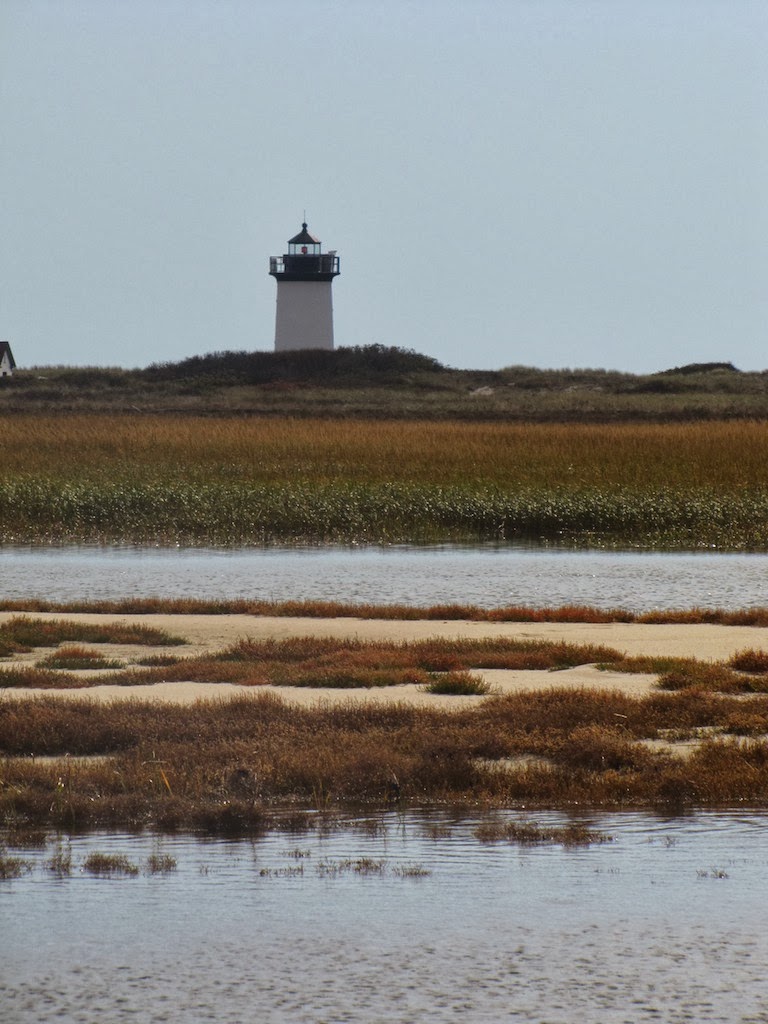
We never saw the sandbar that prompted the trip, but we ended up walking along the Provincetown Breakwater:

That turned out to be quite promising for speed runs, since it's long, has a couple of bends for sling shots, and is 4 ft or less above the water level at high tide. I created this web page with additional details. Will we sail there? Who knows... Skaket is half-way on the route to Ptown, and lots of fun. But maybe next time we arrive at Skaket and the waves look to crazy in 35 mph wind.

A few more pictures from the walk:


Monday, October 21, 2013

Fun at Skaket Beach

We scored a session yesterday at Skaket Beach in Orleans. My friend Martin asked how Skaket is, so here's a short movie to answer his question:


We had west wind with averages in the upper teens, just enough to be powered most of the time on my 6.5. Nina was planing a bit less on he 5.0, but still had a blast. The waves at Skaket are nice beginner waves - they come in nice and orderly, and break a little, but never get threatening or too challenging (at least not in wind below 30 mph). Here are a few facts about Skaket Beach:
  • Work well in SW, W, and NW.
  • Westerlies are less gusty than at most other places because the wind comes over 25 miles of water.
  • Good spot for SW (sideshore to side-off) when onshore places like Kalmus decouple (warm winds, cold water).
  • In NW (onshore) wind, you can sail along the beach and stay in waist-deep water.
  • Best time to sail is 2 hours after low tide until 2 hours before low tide. Low tide is doable, but may require a 1/2 mile walk to reach the water.
  • From the Boston area, driving time is about 15 minutes longer than to Kalmus (about the same as Chapin).
  • Plenty of parking, nice wide beach.
  • Uncrowded - kiters prefer First Encounter about 1 mile north.
  • The closest iWindsurf wind meter is "Hatch Beach". The meter is located at First Encounter, and reads about 3 mph high when the wind is around 20 mph. In stronger winds, the readings seem to be a bit closer to the real wind strength.
  • Mostly an off-season spot - the parking lot fills up quickly in the summer.
It's usually a good idea to sail early, since westerly winds tend to be strongest in the morning, and often drop more than predicted in the afternoon. But we have had great afternoon sessions at Skaket, too.

Thursday, October 17, 2013

Is this really fall?

Temperatures in the mid 60s (18-20ºC); lots of sun; little wind - is this really fall? In Germany, this would count as a slightly cooler summer... so I'm definitely not complaining. Yes, I often need to use my 8.5 m sail and my big slalom board if I want to plane, but I'm nice and warm in a 3 mm short-sleeved wetsuit.
On one of the beautiful windless days, we went for a little after-work SUP session on a Middle Pond in Marston Mills, 5 minutes from our house. The leaves are starting to turn red, and the sun was going down, so it was quite beautiful. A GoPro movie with some scenes from the trip is below. Sorry for not cleaning the lens before filming - I'm so used to have it get wet while windsurfing that I did not even think about cleaning it before the SUP session.

Wednesday, October 16, 2013

GPS speed in jibes: the movie

After seeing my last blog entry with movies from practicing jibes on flat water, a fellow GPS addict asked me: "How fast was your minimum speed in these jibes?" Answering this question took me a while, since I wore two different GPS units that day: the Locosys GT-31 and the FlySight. Let's start with a movie that shows two jibes, overlayed with the GPS speeds:


The first jibe was planed through. The FlySight gives a minimum speed of 10.19 mph, which seems about right. But the GT-31 shows a minimum speed of just 5.19 mph, which is clearly too low.

The second jibe was into a lull, and therefore not planed through. The two GPS units show a minimum speed of 6.2 mph (FlySight) and 7.07 mph (GT-31). The positional data and the doppler speeds for the two devices are a lot closer than for the first jibe.

Unfortunately, I used only the GT-31 at the start of the session, when the wind was strongest. I added the FlySight after about 20 minutes, after seeing that conditions were perfect to lay down nice jibes. For the time where I wore both units, the minimum speed in my best jibe was 11.4 knots; the GT-31 had a much lower minimum speed of 9.3 knots. The discrepancies between the two units were larger if the jibe radius was small (35-40 m instead of 60-70 m for wide jibes), and if the positional GT-31 data seemed less accurate (as in the first jibe in the movie above). I looked at a number of jibes on the videos, and whenever the units disagreed, the FlySight seemed to be more accurate. No surprise here, this is what I saw the first time when I compared the units.

I have sailed East Bay only a few times in planing conditions, but my search for a better GPS for jibe analysis started after another East Bay session. Just like back then, the GT-31 results differ dramatically between the positional data and the doppler data, with the doppler-based results seeming too low. In contrast, the FlySight data give almost identical results with or without doppler. The more accurate FlySight data form a much better basis for further jibe improvements, especially when synchronized with GoPro footage. In my best jibes last Saturday, I kept about 50-56% of my entry speed through the entire jibe. That's decent, but I think there is definitely room for improvement. I have a few things that I want to try out - can't wait for the next flat water session!