Friday, July 18, 2014

The 5 GPS Comparison

I received two additional Canmore GP102+ GPS units today. With not much wind in the forecast for the next few days, I decided to drive around a bit to test them. I mounted a total of 5 GPS units right next to each other on the dashboard of my car: two Locosys GT-31s, a FlySight, and the two new GP102+ units.

I drove around for about 20 minutes at speed similar to typical windsurfing speeds - 30-50 mph. Here's a Google Earth overlay of all 5 tracks:
I uploaded all tracks to ka72.com, so you can download the tracks or look at the Google overlays there (filter by track type "Driving", and look for "Osterville, MA, USA" tracks from July 18, 2014).

Most GPS units do well when you sail or drive in a straight line at constant speed, but some have accuracy problems during turns, for example in jibes. I drove around in circles in a parking lot to check for problems - here's a blowup of this section:
Tracks from the two GT-31 units are in yellow; from the Canmore GP102+ units in green; and from the FlySight in purple. All tracks are reasonably close, except for one of the GT-31 tracks. This track happens to be from the unit I have been using for a couple of years (the other GT-31 track is from my wife's unit, which has been used a lot less). A look at the speed graph also shows big differences between these two units:
For the better unit, speed and doppler speed tracks are smooth and close to each other. For the other unit (light green tracks), the speed tracks have lots of spikes. The doppler speed tracks look better, but still show some minor spikes.

In comparison, the speed tracks for the GP-102 units are more similar:
In this case, the speed calculated from position data and the doppler speed are very close, but the doppler data show fewer artifact peaks. This illustrates why we definitely want to use doppler speeds for higher accuracy.

To see what caused the differences between the two GT-31 units, I looked at the trackpoints. The better unit tracked anywhere between 8 and 10 satellites; the "spikey" unit tracked only 5-6 satellites. Both units had a virtually identical view of the sky. The differences also existed when I checked the satellite screen on both units in my backyard.

No surprise here - the more satellites a GPS device can track, the more accurately it can triangulate the position. Five satellites is the bare minimum (according to the settings suggested by GPS-speedsurfing.com). However, even the "bad" unit always tracked at least 5 satellites, and the error estimate (HDoP) was 2.2 or less for all points (GPS-speedsurfing.com suggests to remove points with HDoP above 5.0).

I do not know why one of the GT-31 units was able to track 8-10 satellites, while the other was only able to track 5-6 satellites. But whatever the cause, the difference in accuracy was quite pronounced. This is quite visible when we compare the speed results that ka72.com gives for the tracks:
The first GT-31 units has substantially higher top speeds than the other units tested (I suggest to ignore the "alpha 500" values, since I did not simulate a alpha run while driving - this value includes multiple full circles from the blowup image above). Taking the values from all 5 units in the test to calculate a standard deviation allows us to see which units give results that fall within one standard deviation of the average. Both Canmore GP-102 units do for all values, but the GT-31_1 unit consistently outside this range.

In this test of two GT-31 units and two GP102+ units, the GP102-units gave overall more accurate results. This is by no means surprising, since the GP-102 units use a newer GPS chip (the Sirf IV), which contains multiple improvements over the Sirf III chip used in the ancient GT-31. One of these improvements is the number of "channels" for tracking satellites: the Sirf III in the GT-31 has only 20 channels, the Sirf IV in the GP102+ has 48 (more about this here). This alone means that the GP102+ should generally be able to track more satellites, resulting in more accurate data.

The results I describe above creates an interesting dilemma: should I keep using my old GT-31, which I know to be less accurate, or should I start using the GP102+? The GPS Team Challenge currently lists the GT-31 as a device "valid for the purposes of the challenge", along with a number of Garmin GPS devices that are known to be less accurate than the GT-31. But no new devices have been approved since the GT-31 was released many years ago (the "GT-35" that is listed was never commercially available).

If I play by the rules, I have to post results from the GT-31. I cannot post results from the FlySight, which is clearly much more accurate than the GT-31, or from the GP102+, which is at least as accurate as a "good" GT-31. From the results I have shown here and in previous blog posts, I will be "rewarded" with higher speeds, since the lower accuracy of the GT-31 tends to result in higher speeds.

Or I could ignore the rules, and post results from one of the more accurate GPS units I have. Sure, these units are not perfect - we'd ideally want more raw data, including number of satellites tracked and error estimates. However, it does appear that the newer units always will track more than the number of required satellites, and provide more accurate data that a GT-31 unit that still gives data points within the limits specified on GPS-speedsurfing.com.

I know two local racers and slalom sailors who are looking for a GPS so that they can be part of our team. I'd really love it if they'd post their speeds - it would be a sure way keeps our team from fighting for the second-to-last place in the monthly rankings. Who knows, maybe we can even dream of making it into the top half in a lucky month! Both of them would buy a GT-31, but they are not available in the US anymore. Should they really pay 2x or 5x as much for an approved Garmin unit, instead of buying a more accurate Canmore G-Porter GP102+? Maybe it is time to change the rules!

Tuesday, July 15, 2014

A smaller, better, cheaper GPS?

For many years, the only recommended GPS for speedsurfing was the Locosys GT-31. It relied on technology that can only be called ancient - so ancient that the company had to stop producing them because they could not get the parts anymore. During the last couple of months, it has been impossible to get a GT-31 in the USA.

This created a problem for new speedsurfers. Several asked me recently what they should buy, and I could not give them a recommendation. The speedsurfing sites officially allow some Garmin watch-type GPS units, but label them clearly as inferior to the GT-31. But when I recently checked their prices on Amazon, I noticed a promising GPS unit: the Canmore G-Porter GP-102+.

On promising detail about the GP-102+ (I'll call it the "GP102" from now on) is that is uses the Sirf4 GPS chip. That's the successor to the Sirf3 chip that the GT-31 uses, and it has a number of improvements. The other thing I liked was that the unit only costs about $50, compare to about $150 for the GT-31. I went ahead and bought one to test it.

Two days ago, I had a chance to use it while windsurfing. I did two sessions, a freestyle session in 15-18 knots in the morning and a speed session in 20+ knots in the evening. For comparison, I wore my GT-31. In the morning, I also wore my FlySight GPS, which I previously reported as being more accurate than the GT-31. However, the FlySight does not have a display, is not waterproof, and costs $250.

I plan to post a more detailed report later, but here are some initial results. I'll start with the tracks from the first session:
GT-31(blue) vs. GP102 (red) tracks
Very similar tracks, very similar speeds. A different view shows some artifacts in the GT-31 tracks:
The artifacts are from wet jibes. The GT-31 tends to loose the GPS signal when you're swimming, and the positions jump around a bit. Here's a blowup from one wet jibe:
Tracks and speeds from one wet jibe, showing artifacts in the GT-31 data (blue) that are absent in the GP-102 data (red).


Here are the tracks from the second session (with reversed colors):
GT-31(red) vs. GP102 (blue) tracks from session 2
Here's how the speed results compared in the GPSTC disciplines:
In general, the results are almost identical, with differences typically being around 1% or less. The one exception is the best alpha 500 from session 1, where the GP-102+ was 3.5% lower. Here's this part of the GPS tracks:
The blue GT-31 tracks shows a very sharp turn, which did not happen (I sometimes do jibe with a hook like this, but not without loosing all speed). This is often seen in GT-31 data during low radius jibes: the track continues forward for too long, then turns too sharply. The effect is that the distance covers appears larger than it really was (the difference is about 2 meters). In other words, the GT-31 speed for the best alpha was artificially high. I have seen the same issue many times when comparing GT-31 and FlySight data.

One of the good things about the GT-31 is that is also records accuracy estimates of the data. In sharp turns like the one above, the GT-31 "knows" that it is not accurate, and many data points have SDoP and HDoP values above the commonly used threshold. But from what I can tell, these data points are still used in GPSResults to calculate alphas.

The GP-102+ produces files in Garmin .fit format, which (as far as I can tell) do not contain any precision data. This might seem as a big drawback - but look at the next table first:

The table shows the difference in speed calculate using Doppler data and positional data. For the GT-31, this difference is large: 28.3% for max speed (2 s), and 10.5% for alpha 500. This is no surprise, and the reason behind the request to always use doppler data when posting to GPS web sites.

But for the GP-102+, the differences are much lower: just 1.4% for max speed, and 1% or less for everything else. In other words, the relative positional accuracy is much higher than for the GT-31. Here's a section of the tracks which show spikes in the GT-31 positional speed data:
Positional vs. doppler speed for GT-31 (red) and GP-102+ (blue)
Why is this relevant if we only use doppler values for speedsurfing? Simply because positional and doppler data are not fully independent. In the example above, the artifact spikes are missing in the doppler data, but the data near spikes often have substantially lower accuracy values. In one GPS unit from a different manufacturer that I tested, spikes in position speed went up to more than 1000 knots! 

I'm a software guy, not a hardware guy, but I know that there is a lot of computation going on to convert the raw GPS signals to positions and speeds. To my eye, the spikes in the GT-31 data simply look like the results of a bug. In later chips and GPS units like the GP-102+ and the FlySight, this bug seems to simply not be there.

This is it for today. The results from using the Canmore GP-102+ for speedsurfing are very encouraging, so I just had to share some of this right away. Stay tuned for more details and tests...

Please note that the GP102 is not waterproof! Several users (myself included) had units break after minimal water exposure. This can happen even inside a water-proof bag if just a little bit of water gets inside the bag. I strongly recommend to double-bag the GP102: put it inside a zip lock bag, and then inside a waterproof armband.

Tuesday, July 8, 2014

Summer winds

The wind will stop tomorrow (or maybe the day after), and I am glad. Can you believe that? I can't. But it is true. I sailed 6 out of the last 9 days - full power every time, often long sessions, sometimes two sessions a day.


Yesterday's high wind and low tide called for some slalom/speed practice, so the XFire 90 got some use again. I got up to almost 30 knots on water that was definitely not perfectly flat. Not bad (for me, that is). I sailed 95 km overall. Marty sailed 115 km. Marty tried loops, did upwind 360s while overpowered on 4.7, and more. Marty is an animal. I love sailing with Marty (and with Jon, who made a rare guest appearance).

Today called for freestyle. I tried the Kono with the 360 entry. It helped to be nicely overpowered on 6.5 (Marty was on 4.7). Made some progress - I go the board to jump twice. On another try, I got around to backwinded while still planing. Did not matter that I could not do both in the same try - falling backwards into the warm water was lots of fun. Maybe I'll get the Kono one of these days on perfectly flat water. Or with a helping pushy wave. Or maybe I'll just get a slightly wet 360 in the straps with a board flare. At least I can use a big fin! And I'm not too scared to try. Maybe big fins make me brave. Until I end up sliding backwards, the big fin stays in!

Thursday, July 3, 2014

Splash, splash, splash

I'm tired. It was windy 3 days in a row. I got 4 session in, sailed probably about 200 km (the GPS refused to cooperate one day). That would not be so much, except that I copied Nina and Marty. They are both better windsurfers than I am. I think their trick is that they fall a lot. So I tried to fall a lot, too. When you fall, you need to waterstart. Waterstarting makes you tired! So there. That's the story. Told in pictures:
Jump jibes are fun. You are supposed to fall! Poking the sun with the nose of the board gets extra style points.

You're not supposed to fall in duck jibes. But plank walks after the mast hits the water are fun, too.
A splash before the fall
Marty duck jibing. Every now and then, he just turns around instead of falling.
I did not want to mess up my jibe completely, so I had to do other things. Jump jibes are my favorite - you are supposed to fall - what can go wrong? Well, you are also supposed to get right back up with a clew-first waterstart, flip the sail, and sail away. Needs more practice.

Duck jibes are easier. They are my "look, I can do tricks, too" thing. If I sail long enough, I re-discover the ways to mess up duck jibes. Having the mast hit the water so that the board stops, but you keep going at full speed, is my favorite. Then, Nina told me she simply pulled the mast back up after it hit the water, and completed the duck jibe. I had to try that, too, and it worked.

Nina and Marty fall all the time, not just when they are tired. So I needed to try other things, too. Going switch before jibing seemed like a good idea. That worked, but the jibes ended up a bit boring, and I did not fall all the time. Then I saw Marty try a duck tack. Nina tries them, too, and now catches the sail again most of the time. So I figured I just had to try my first planing duck tack. Took some convincing, though - I'm not sure I was really still planing when I finally threw the sail. Success! No, I did not make a planing duck tack on the first try, silly! I managed to fall!

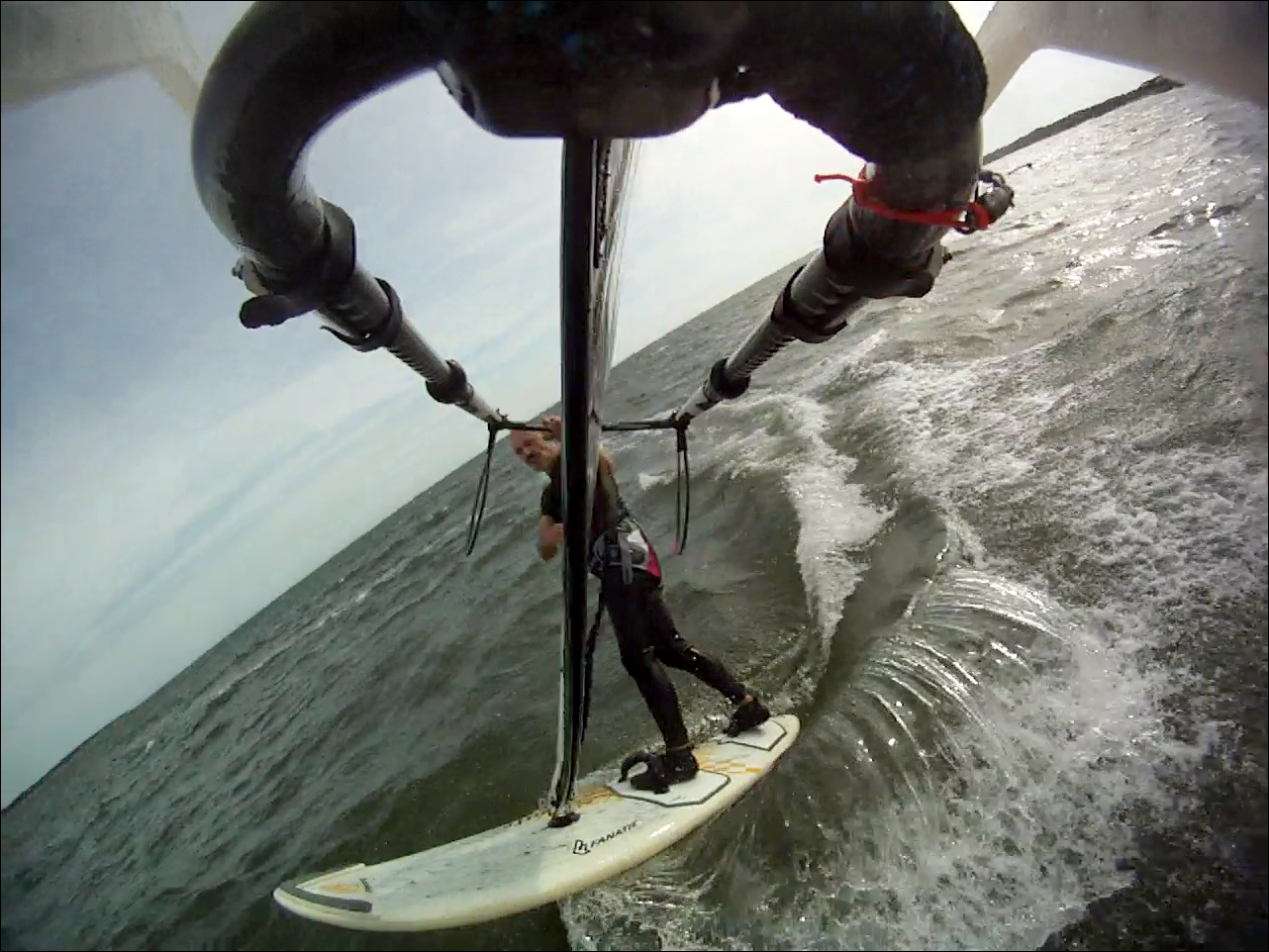
All the falling was wonderful, since the water was just perfect, and I probably would have gotten hot if I had stuck to my usual lawn-mowing ways. But I was not sure if I was getting any better. So on the third day, I decided to spy on Marty: I made him use my GoPro with the Clew-View mount. He proceeded with his usual up- and downwind 360s, heli tacks, push tacks, duck jibes, donkey jibes, and who-knows-what-else. Oh the things I could have learned from the video! When I saw him do a beautiful early-throw switch duck jibe, I waved him over to make sure the camera was still recording. It was not :-{. The stupid extra battery that I had put in apparently had been almost empty, and recorded exactly 90 seconds. In these 90 seconds, Marty did an upwind 360 and a duck jibe. Makes me wonder - what would we have seen in an hour of video? Maybe we will find out soon - the next stretch of 3-4 windy days is coming up this weekend.
--
On a different topic: many thanks to all the windsurfers who have donated to our campaign to bring Caesar Finies to the ECWF Cape Cod on September 13-14. We were able to reach our fundraising goal of $1200 to pay for Caesar's airline tickets in 6 days. Fantastic!