Monday, March 16, 2015

Thanks, Phil and Danielle!

Yesterday, I wrote that I want to learn to plane switch stance. Today, I noticed that the getwindsurfing.com team had released a new video yesterday - about how to sail switch stance! Here it is:

Perfect timing! I love Phil's and Danielle's instructional videos, they make things seem to easy. Of course, I had to compare their suggestions on how to get switch while planing right away with the Tricktionary instructions. Phil actually describes two ways:
  1. Strap-to-strap: the back foot goes straight from the back strap to the second front strap, followed by the old front foot going into the back strap.
  2. Jibe footwork: the back foot is taken out of the strap, and placed before the strap. The front foot is twisted out, and placed before the back foot heel-to-toe, just like you would during the foot change in a jibe. Then the old back foot goes into the front strap on the other side, and the old front foot goes into the back footstrap.
The Tricktionary shows two different approaches:
  1. Jibe without foot switch: jibe in the straps, flip the sail, but do not switch the feet - keep sailing in switch stance.
  2. Three steps forward: take the back foot out and place it in front of the back strap; take the front foot out and place it in front of the front straps; move the old back foot into the front strap while twisting the hips; step the old front foot into the back strap.
I have actually tried both Tricktionary ways at least a few times. The "jibe without foot switch" way works to some extend, but I tend to loose too much speed. Even in a decent planed-through jibe, it is normal to loose 40-50% of your initial speed, so I think this approach works only when well powered on very flat water.
I have had even less success with the "three steps forward" approach. There is not a lot of space for my size-12 feet between the front straps and the mast foot, and things feel a bit claustrophobic if I have both feet forward. My tries usually resulted in crashes, so I have not done many.

I have not tried the two approaches Phil suggests. The strap-to-strap move is clearly the fastest. I checked some trick movies on continentseven.com, but most do not show the foot switch; in the few movies that do, the strap-to-strap entry is most common. That's two good reasons to try it this way.

But using the jibe footwork also seems attractive. The footwork is familiar from thousands and thousands of jibes, so there are fewer new things to learn. That might just make it a bit easier to concentrate on the new things - going fast while being all twisted up. So I'll give this approach a try, too. Don't hold your breath while waiting for a report, though - we got a bit of fresh snow on the ground last night, and below-freezing temperatures in the forecast. The trip to Cape Hatteras can't come soon enough!

Saturday, March 14, 2015

Backwind Jumps

The title of this post is misleading. This post is really an illustration how careful one has to be about what one writes on the internet. You never know what kind of ideas you put in peoples heads!

Regular readers of this blog may have noticed that I have not posted my typical crazy theories about freestyle moves this winter. Some may even have hoped that they'd make it through this winter without being exposed to yet-another freestyle theory that is obviously completely wrong. Hah - zu früh gefreut! Here is my new theory:
  • For some freestylers, the first "new school" freestyle move should be not be a Vulcan, Grubby, or Flaka, but rather a backwinded move: a Shaka, Switch Kono, or Funnel. 
A few of my back-and-forth-sailing friends may now wonder what the hell I am talking about, so let me show you a video of a Funnel:


How could I possibly think that's the first new school move to learn? I'll blame tim319. On a thread about learning the Flaka on the British windsurfing forum, he posted this:
"I think I'm gonna crack funnells in much less time.
Apparently as soon as you start to get them you make the majority."
Interesting enough to prompt a few Google searches. Very quickly, they turned up this statement by Flo Söhnchen, a top German freestyler:
"Der Funnel ist eigentlich relativ einfach" (The Funnel is actually relatively simple)
That is quite a contrast about what he writes about one of my previous favorites, the Flaka:
"Durchhalten! Irgendwann klappt das verdammte Ding! :)" (Keep at it - you'll get the damn move eventually!)
And about the Grubby:
"Irgendwie find ich es recht schwierig, den Move richtig konstant hinzubekommen" (Somehow, I find it quite difficult to make this move really consistently)
Now back to what Flo says about the Funnel:
"Was den Move schwierig macht, ist das Duck-Schiften des Segels in der Switch-Stance-Position vor dem Absprung." (What makes the move difficult is ducking the sail from switch stance before the pop)
So, if you already know how to duck the sail while planing switch, the move should be easy! Admittedly, this is a difficult skill - I have read that it is more difficult than learning the Vulcan. But I know at least two women who learned the planing Duck Tack before the Vulcan - my lovely wife Nina, and Marji from Bonaire. There are a couple good reasons to learn the planing Duck Tack before starting with new school tricks. One is that is has a light-wind counterpart, which can be quite helpful to learn the sail handling (which is, indeed, non-trivial); the other one is that the crashes look a lot less dramatic than Vulcan crashes. The light-wind Duck Tack is also a move that can be done in almost-planing conditions, and with a high success rate once you learned it - two things that install confidence.

So, if we assume a windsurfer can do the planing Duck Tack, and that she can plane switch in the straps, is the Funnel really a good move to try? That still seems highly questionable for the following reason:
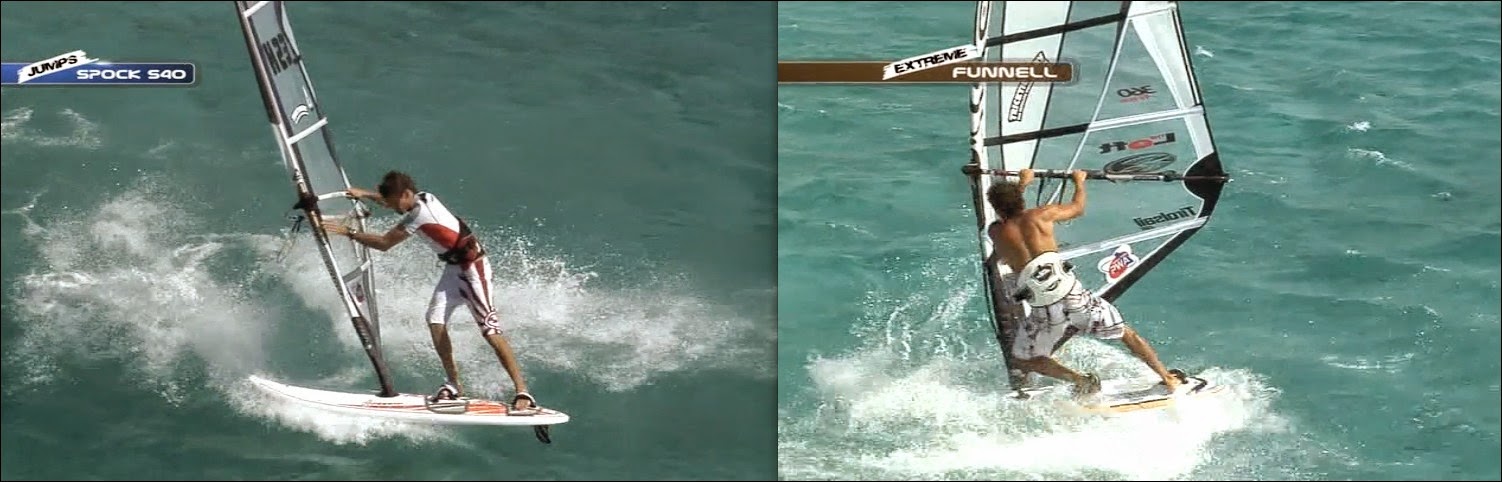
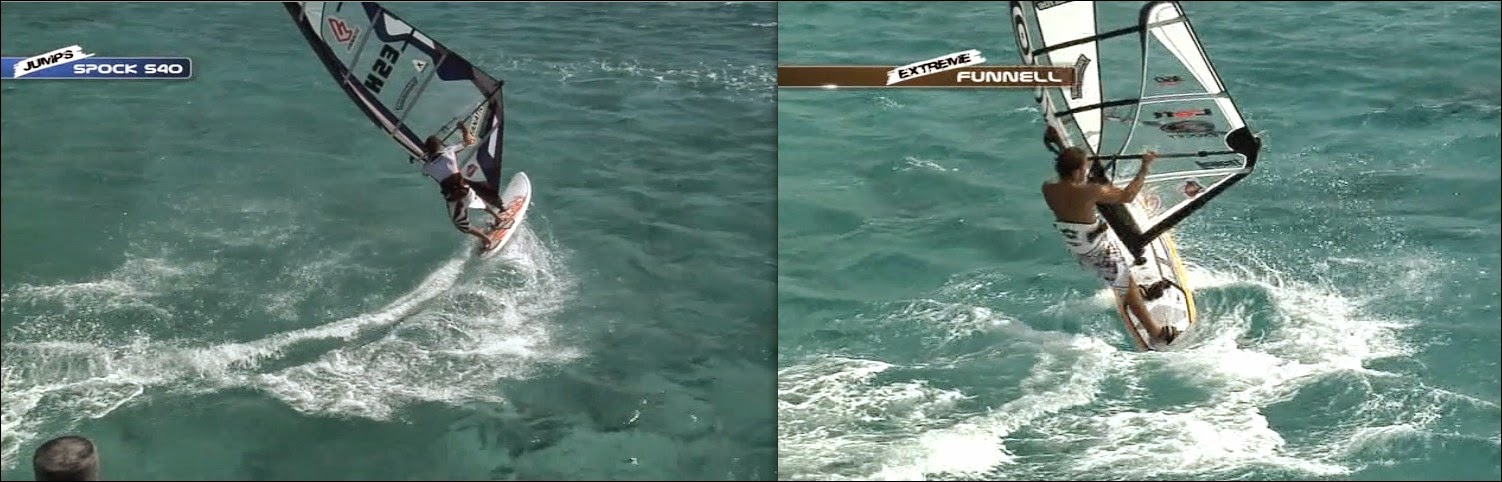
  • Looking at just the board movements, the Funnel is the equivalent of a Spock 540: the nose is jumped downwind to turn the board 180 degrees into a backwards slide, followed by an additional 360 turn while sliding
  • The Spock 540 is the trick you learn after the Spock, which you learn after the Vulcan; many who have learned them all say that it takes just as many tries to learn the Spock as it took to learn the Vulcan.

It it wasn't rainy and cold outside, I might just stop here, and ignore what tim319 and Floh said (and perhaps remember that so far, I have had quite limited success planing switch, and never even tried a planing Duck Tack, although I have the non-planing version down). But it is rainy, so we'll continue by carving the moves into little pieces, and comparing them.

1. Preparation

For the Spock 540, there is not much to do - get over the board for a pop, instead of staying more out like you would for a chop hop. Easy enough to do.
For the Funnel, you have to go switch stance, and then duck the sail, without loosing to much speed. Definitely much harder!

2. Take off

In the Spock, the sail is upright and depowered. That's quite different from chop hops, where the sail is to windward and powered. 
In the Funnel, the sail is backwinded and slightly forward. The pressure in the backwinded sail helps to get air. If you don't jump, the backwinded sail will throw you backwards - but if you've worked on 360s, you know that these crashes are harmless and often even fun.

3. In the air 

In the Spock 540, we have to let go of the backhand, and switch hands to the other side of the boom. We also want to push the nose down to create a rotation point. That's a lot of things at the same time, while the board is in the air - one of the things that make learning the Vulcan (the first phase of the Spock) hard.
In the Funnel, we have held on the the boom the entire time - not so hard.

4. Sliding backwards

We have turned the board 180 degrees, so our stance has switched: in the Spock, we are now switch stance, while in the Funnel, we are regular stance.  If you stop the Spock here, you have a Vulcan. You could stop the Funnel here, too, but nobody seems to do that. If you did, you could sail away in a regular stance, rather than from a switch stance as in the Vulcan. The sail now needs to go towards the nose of the board to continue the rotation. This seems easier in the Funnel, where we are in normal stance, and more difficult in the Spock 540, where we are switch stance.

5. After turning 360 degrees

We are backwinded and sliding. In the Spock 540, the body is twisted up - relative to the regular backwinded stance, we are in switch stance. In the Funnel, the stance is almost identical to the stance before takeoff, except that the sail is still more forward to push the nose around for the final half-turn.

6. Exit
In the Spock 540, the sailor exits in switch stance; in the Funnel, the exit is in normal stance.

In summary, the Funnel does seem quite a bit easier after the initial preparation, since we do not have to switch hands on the boom mid-air, and are in a normal stance through the entire rest of the move. So perhaps we can believe tim319 and Floh!

I am not claiming that the Funnel is much easier to learn than the Spock 540. It's possible that it is actually more difficult; after all, the Tricktionary 2 still had it listed in the "Extreme" section. However, it appears that the hardest part of the Funnel happens before takeoff. This part can be learned without any jumping or popping! Since the crazy crashes that we see when guys try to learn Vulcans and Spocks are eliminated, the fear factor is greatly reduced.

Additional motivation to learn the planing Duck Tack and the switch duck in the straps is that it leads to the Switch Kono. If you've ever seen Kiri Thode or Tonky Frans throw a sky-high Kono on perfectly flat water in Bonaire, you'll agree that this is a very cool looking move. Perhaps more importantly, it is the only new-school move that does not scare me at all, for a very simple reason; when working on Carve 360s in the straps, I got thrown backwards by the backwinded sail many, many times. Some of those times, most of the board was in the air, and I got the nose turned enough to get a bit of wind into the sail again from the right side. In the worst case, those falls were harmless; typically, they were a lot of fun, even if it was windy enough that I'd stop doing duck jibes.

So, I got two tricks I'd love to try, the Switch Kono and the Funnel. To get there, I'll probably first need to catch up with Nina a bit, and finally work on the planing Duck Tack. So that gives a couple of high wind goals for the upcoming ABK camp in Hatteras: 
  1. Planing switch in the straps
  2. Ducking the sail while planing switch
There. I said it. Now I have to do it. Then we'll see what that leads to. Maybe I'll throw in a few Shove It/Shaka tries while we're down there - after all, they are backwinded jumps, too. 

Thursday, March 12, 2015

Back on Cape Cod waters

Texas was great. Texas was warm. Guess what the problem is with coming back from a warm place! You're right (maybe): going out again to windsurf in the cold.

We have been back for more than a week now. One day, Jerry asked who would go windsurfing with him in Chatham. I love windsurfing in Chatham! The wind was great! But I did not go. Temperatures were below freezing, and I was still in Texas mode. Texans don't windsurf when temperatures are close to freezing. Maybe that's infectious?

But it has been thawing for a few days now. We even saw temperatures approaching 50ºF (10ºC) yesterday. The snow in the backyard is only a foot deep now. The streets are free of snow and ice - well, at least in the middle they are. Even some of the side streets are wide enough for two cars again!

The forecast for today predicted northwest winds in the 20s all day. Sure, NW tends to be cold, but temperatures stayed above freezing. And it was sunny! I'm sure you understand that I just had to go windsurfing. Some may think it's just because Pete called me a "wimp" when I did not join Jerry a few days ago. That's probably not true. I think it's just my addiction acting up. Two weeks without my favorite drug is too much! That's 14 days!

For NW wind, one of my favorite spots is Skaket in Brewster. But the Skaket web cam shows that there is still a lot of ice on the water there, so Skaket was out. Other spots nearby had 2 m high "icebergs" being washed ashore, so staying away from other Cape Cod Bay beaches seemed wise. But the tides were right for a Barnstable Harbor session in the afternoon.

I went to check it out yesterday around noon. The water was practically free of ice - great. I posted pictures on FaceBook and iWindsurf to perhaps get some company, but all I got was warnings about icebergs and stuff floating in the water. Blame Hollywood! I think "Titanic" really got stuck in people's head.

So I went alone. I underestimated how much time it would take me to move boards out of the van that still were in there from the Texas trip, so I got a late start. I also dressed warm enough for a swim in the near-freezing water, and getting my Ianovated wetsuit over a second layer of long neoprene pants and a neoprene shirt took some heavy pulling and patience.

When I got to the town landing, the wind had dropped from 30s in the morning to what looked like low 20s. All the meters had shown a lot of variability in the wind, so our came the big board (Skate 110) and my magic sail (Matrix 6.0). Scared of all the talk about things in the water, I put a short Delta fin from Maui Ultra Fins into the board - with a rake angle of 55 degrees, the fin will go over things in the water that would cause catapults on most other fins.

Out I went, planing right away, even though there tends to be a bit of wind shadow near the launch site. A couple of tacks, and I was in the flat water next to the marsh islands. I did not have enough power for speed runs, but I love sailing and jibing in flat water! It also made it rather easy to stay dry for my entire session. Sure, I played chicken and did not try any tricks that would have increased the chances of crashes and the resulting ice cream headaches - but hey, I was all alone on the water, and I never unlearned how much fun it is simply to plane on a windsurf board. I used the blow tubes in my Ianovated wetsuit a lot today, but that allowed my hands to stay warm, even in the open palm mittens I used. Nice!

I cut the session short after an hour when the wind dropped, and the rising water levels started to hide some of the little islands that had flattened the water out so nicely before. I had a lot of fun, and was really happy that I had gone out. It only gets warmer now! I hope to see some friends on the water again soon.

Here is a short video that shows the conditions today:

Saturday, March 7, 2015

Two Sets of Right of Way Rules

This post should not be necessary. I should instead write about how much fun Nina had sailing the F2 Missile in Corpus Christi, and how she said "it's so easy to schlog" (all 62 liters of it).

But a recent discussion in the Australian Seabreeze showed that there are windsurfers out there who are fully convinced that they understand the right of way rules, but actually do not. I had encountered this problem before, when a windsurfing instructor who had taught hundreds of students explained the wrong right-of-way rules in a certification course. That terrified me a bit.

Why did he explain the wrong rules? He had learned the right-of-way rules for power boats, and thought that the same rules apply to sailboats. That appears to be the case - but only at first glance!

This is the rule for powerboats:
"A vessel approaching from the port side must give way." 
 In other words, the starboard boat has the right of way, and should maintain its course. Or simply "the boat on the right has the right of way".

Here's is the rule for sail boats (including windsurfers and kiters):
"The boat on starboard tack has the right of way."
That seems to be the same thing, right? A quick Google image search may even confirm this - here's a picture for power boats:
 And the corresponding image for sail boats:
That's almost the same! The only difference is that the direction that a powerboat change course is defined ("to the right"), while sail boats may change course in either direction.

But hold on - what happens if the wind comes from another direction - say, from below in the diagram above? Nothing changes for power boats, since they don't care about the wind. But for sail boats, this happens:
Now, the sailboat on the left has the right of way, and the sailboat on the right must evade! Here's the little thing that's easy to miss:

  • For powerboats, the right-of-way rules refer to starboard and port as defined by the front and back of the boat 
  • For sailboats, the right-of-way rules refer to starboard tack and port tack, which are defined by where the wind comes from! If the wind comes from starboard (the right), we are on starboard tack; if the wind comes from the left, we are on a port tack.
So for two sailboats on opposite tacks, the powerboat rules (which are defined relative to the boat) will give exactly opposite results from the sailboat rules (which are defined relative to the wind) about half of the time!

I can already hear the argument "but in the image above where the wind comes from below, both windsurfers are going far downwind - that never happens on the water!" True enough - windsurfers mostly sail on  a beam reach. Let's look at diagrams for two boats on a head-on collision course, then. First, here is the powerboat diagram:
Note that both powerboats are supposed adjust their course to the right. For sailboats, the diagram is different:
Here, the boat on the right is on starboard tack and supposed to hold the course, while the boat on the left has to change course. If the wind comes from below instead of above, the roles reverse:
So far, I have talked about "right-of-way rules". That is how these rules are often referred to, but unless you are sailing in a regatta, a better name would be "what-to-do" rules. In the head-on collision case shown above, it's quite obvious that it really helps if both sailors know what they are supposed to do. At least one sailor has to change course to avoid collision; but if both sailors change course, there's a good chance they are still on collision course afterwards! If you often windsurf in crowded conditions, you've probably experienced what this leads to - both of you in the water!

Fortunately, there is a very simple rule for windsurfers to remember: if you are on a collision course with someone on the opposite tack:
  • Right hand is closer to the mast: keep your course
  • Left hand is closer to the mast: change your course to evade collision
Keep in mind, though, that there are plenty of windsurfers (and kiters) out there who never learned the right-of-way rules for sailboats, or who think that powerboat rules also apply to windsurfers. In case of doubt, do whatever it takes to avoid collision. Common courtesy suggests to give beginners and all sailors who are obviously struggling plenty of space, regardless of "right of way".

Just to be complete, I'll end this post with two more right-of-way rules. The first one is that a boat passing another boat on the same course has to stay clear:

Finally, if two sailors are on the same tack, the leeward sailor has the right of way:

There are plenty of sources on the web that explain the right-of-way rules. Some of the powerboating sites fail to even mention that different rules apply to sailboats; others, like boatus.org, have at least a brief explanation. One good explanation that I used as the source of most of my diagrams is http://spinnaker-sailing.com/online-courses/lesson-3.