Saturday, April 25, 2015

GPS Speedsurfing with your phone

Can you use your phone for GPS speedsurfing? Some GPS pioneers like Roo have said "absolutely!" for a few years already. With the recent production stop of the "gold standard" GT-31 GPS unit, this question has become more urgent. Several replacements are on the horizon, but none are available yet.

So Manfred Fuchs, author of the widely used program GPSResults, has developed an app for Android phones for speedsurfing called GPSLogIt. It not only logs GPS data to a file for later analysis, but also shows results for the last and best run of the session, and even tracks:
As a geeky wanna-be speedsurfer, I had to try it, so I bought a cheap Android phone on Amazon.com (RCA M1 4.0 for $67), installed the GPSLogIt trial, and tried it out as soon as we got some wind. For comparison, I used my GT-31. Results were quite encouraging - most numbers were very close, although the long distance numbers and the alpha 500 where a bit lower with the phone. With the current trial (1.3), I was not able to read the numbers while sailing, or even when taking short breaks on the beach. Part of the problem was that I double-bagged the phone, using a ziplock bag inside a waterproof armband. I had to take the phone out of the armband at a shady place to see all the numbers and tracks. Future versions of the software will probably have a screen with bigger numbers that can easily be read while sailing.

After the initial promising results, a more thorough test was warranted. I decided to compare the phone with GPSLogIt to five GPS units I have: two Locosys GT-31s, two Canmore GP-102s, and the Flysight GPS. Here's a table of the results (raw data are here):
The GT-31 and the Flysight data include accuracy estimates (SDOP), so I included the +/- numbers as shown by GPSResults (for 5x10 seconds, I used a "typical" number for the 10-second runs).

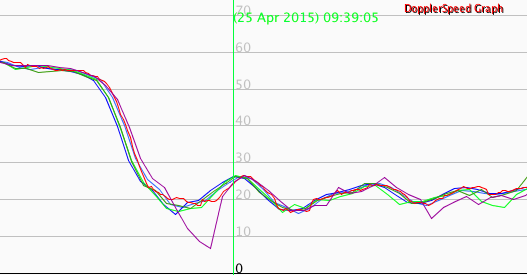
All speed results obtained with the Android phone and GPSLogIt are within 0.6 knots of the numbers the other units gave. The 5x10 second numbers, which are often viewed as the most important top speed numbers, are within 0.1 knots, and well within the accuracy range of the GT-31 and Flysight units. However, the numbers for the nautical mile and especially alpha 500 are significantly lower. A close look at the doppler speed graph and the tracks provides some clues. Let's start with a large-scale view:
Mostly, the data for all 6 units are very close, but there are a few areas in the speed graph where the phone data drop below the other units. Here is a closeup:

There are several short areas in the track where the phone speed is artificially low; this explains why the long distance numbers are a bit lower than for the other units. It is fortunate that the error is on the low side - from the view of a competition, GPS units that understate true speed are acceptable, but units that overstate speed are not.

For the alpha, a look at the tracks when I drove around in circles is illuminating:
Blue: GT-31; red: Flysight; purple: phone & GPSLogIt
The tracks for the Flysight, which uses an UBX GPS chip and records at 5 Hz, is most accurate. The GT-31 tracks are close, but the phone tracks show some obvious deviations. Clearly, the phone had the most problems to accurately track direction changes. This may well be due to processing limitations in the GPS chip firmware that are related to limits on how much battery the GPS chip can drain. As it is, the accuracy is certainly sufficient for the common uses - navigation and photo tagging.

Overall, the GPS accuracy of the phone I used was certainly acceptable, albeit not "perfect". Other phones may use different GPS chips and give different results, but several others have also reported decent accuracy with other phones. Nice to have another option for tracking your windsurfing sessions - and one that's less than $100, even if you buy a phone just for this purpose!

Saturday, April 18, 2015

Three Times Eleven Is Enough

It's getting warm. To warm to stay at home even if the wind is light.
I took the pretty cat out for a ride today. Amazing how the GoPro can make it look small!

A couple of days ago, the lovely Nina joined me for a light wind session. She took the Mistral Pandera and a 5.3 m sail, and had tons of fun in 15 mph wind. I took my BIC wind SUP because I wanted to test my new fin:
It's small - 11 cm, to be exact. When I saw it on the Black Project Fins web site, I just had to have it. Just imagine - put it into the SUP, step a little bit forward, and with a little help from the rocker, I can sail all the way to shore in Hatteras! No more walking!

I figured it would be big enough. When Caesar was here last fall, he never used a fin in light wind. I'm no Caesar. I can sail the SUP without a fin, but need to concentrate so much that I can't do much else. But I have used a 15 cm fin without a problem, so 11 cm should be fine, right?

It took a number of back-and-forth emails to convince Chris at Black Project that I had not lost my mind, but eventually, he mailed me the fin. When I tried it two days ago, I learned stuff. For example, I learned how easy it is to turn a 10 foot 6 board by scissoring your legs when you have a really small fin. It worked, and my previously slow-turning SUP now turned like Nina's Nova.

However, I move a bit slower than Nina, so it turned a tad fast for my taste. Sailing leeside (backwinded) or in switch stance also required just a bit too much attention - not enough pressure on the front foot, and the board turned into the wind.

Then I realized what the problem was: the fin was not too small - it was lonely! There were two unused fin boxes in the board. As soon as I put the two little side fins in there, everything was perfect! All three fins are about the same size, and worked just about 3 times as well as one of them. Surprise! (NOT!!). I have mostly used the board with just one 26 cm center fin in light winds; but 3 times 11 is more than 26! The total area may be a bit smaller, but the board tracked beautifully, even when sailing switch or leeside. Whatever the numbers are - three times eleven is plenty.

Tuesday, April 14, 2015

Kiri Steps Leeside

KUMA Movies  just published another great movie, this one featuring Kiri Thode:

It's a great movie with excellent tricks - the 2013 PWA World Champion in freestyle shows that he is still a serious title contender. Besides the "usual" aerial acrobatic, Kiri also shows some light wind freestyle, including a clew first tack on the rail.

But two other segments caught my attention - here they are:
Twice, Kiri stepped around the mast at full speed before leisurely getting into the foot straps on the lee side and then jumping into a Funnel (to be exact: a Funnel 900 and a Funnel 1620 - that's 4 and 1/2 turns!).

The regular readers of my blog (not you, Jon!) may remember my interest in the Funnel. The usual entry for a Funnel is going switch into the straps while planing, and then ducking the sail. Looks easy and elegant, but is not really easy at all. Walking around the mast sure looks easier!

For once, this is not entirely theory. I have actually played around with the planing backwind jibe during two ABK camps, and found getting onto the other side while planing almost easy. I did not try to get into the straps on the leeside, nor did my backwind jibe attempts succeed, but I got pretty close in fewer than 20 tries. So getting onto the other side and then into the straps appears doable! Whether I will have enough speed left is an entirely different question; even Kiri goes "only" for Funnels, not Burners that require more speed. It may take quite a while before I get to the point where I get into the straps without loosing all speed; but on the way, I may just get the backwind jibe, which is a pretty cool looking move. Stepping around the mast early is also great practice for the planing tack, and my planing tack sure needs some practice!

Let me just point out one big advantage the "step around" approach to getting leeside in the straps has: it works better with larger sails. That's not just what I think, that's what the great Andy Brandt said. So there. When I am comfortable enough to fool around with freestyle, I usually need a 6.0 or 6.5 m sail to get planing; but luffing sails this big from the clew for the duck gets a bit harder. Every once in a while, I may get a perfect day where I can plane on a 5.3, and still feel like doing freestyle. But if it picks up to 4.7 (which means upper 20s for me), forget about it.

Big-sail freestyle; better tacks, cool jibes, Fu's and Switch Konos; and imitating Kiri - what's not to like?

Sunday, April 12, 2015

Welcome, spring thermals!

The wind forecast called for 13 mph. But it was warm and sunny, without a cloud in sight! So the sea breezes kicked in. Kalmus had WSW winds around 20 for 3 hours. The iWindsurf meter showe NNW wind, but that was wrong, as it often is these days - all that snow and ice in the winter must have damaged something. But the wind strength was real!

Nina did not trust the wind to stay up, so I sailed alone. There were a few lulls when the wind thought about decoupling, but I was planing on my 6.5 most of the time. Boston saw temperatures in the 60s today, but the Cape stays cooler during the spring - air temps at Kalmus were in the high 40s (9ÂșC). The water is definitely getting warmer; it's probably in the mid to high 40s near Kalmus. Warm enough for me to work on some tricks, including a few where I was guaranteed to get wet. Fun! Here are a few Clew-View shots:
Warming up with Duck Jibes
Switch Jibe
Heli Tack
Jump Jibe. You know the water is getting warmer when I do these!