Saturday, July 13, 2019

Foil pictures

We had another nice foil session 2 days ago, and Eddie took some nice pictures. Here's Nina on the foil and Gonzalo on a longboard:
Nina was on a 5.2, Gonzalo on a race sail (8.5 or 9.5). He was one of the few windsurfers who was planing consistently - most guys on 7 m sails had a few good runs, but mostly slogged.

Fortunately for me, Nina was a bit overpowered on the 5.2, so she came in after a short session and let me have a turn. I started out on the 6.5:
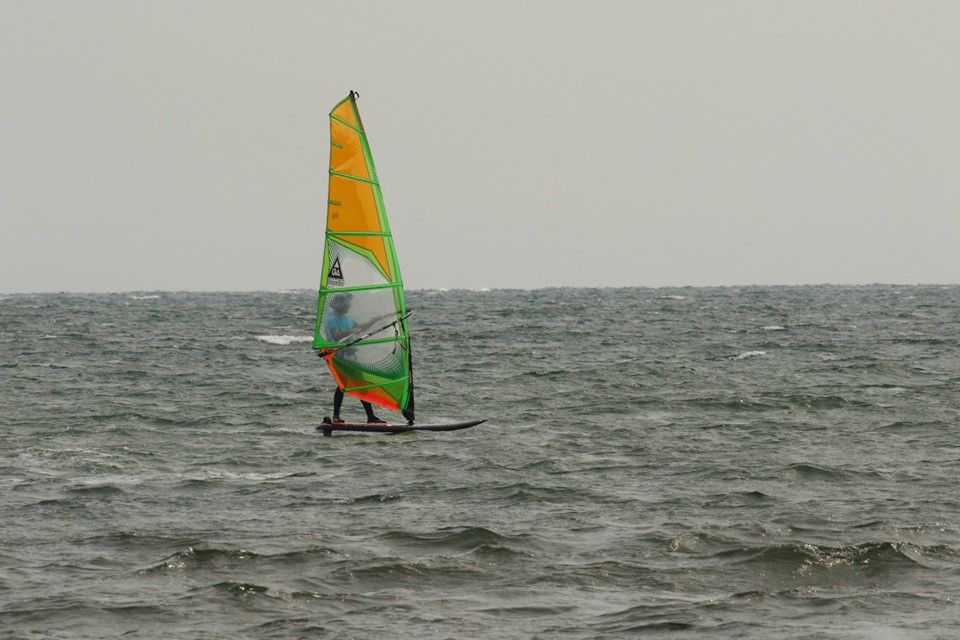
I never like this sail very much, largely because it is low-end oriented, while all my older Gaastra Matrix sails were top-end oriented. However, it was great for foiling, powerful but stable. Cool!

The picture above shows my favorite "flight height" on the 60 cm mast: just barely above the water, so that the board just touches the waves a bit every now and then. One excuse for flying low is that I frequently get spinouts when most of the foil is out of the water. Those are usually not very dramatic, but often end up with the board slapping back down onto the water. The gently touches when flying low are much nicer, and loose a lot less speed. But perhaps it's really just my inner chicken asserting itself.

We took turns on the foil a couple of times, and I used the 5.2 for my second session. Here's another "flying low" picture:

Occasionally, I ended up foiling a bit higher, and I'm definitely making progress controlling the height.
I'm still amazed how much fun foiling is even at low speeds. My speeds typically were around 10-13 knots, with only rare spikes above 15 knots. That's about half of the speed of sailing on freeride or slalom gear! Here are the tracks for the day:
I had a few runs of 700-800 meters, pretty much the entire distance I foiled (limited by shallows on the left, and the stones from the old pier on the right). The longest "high foil" without touching the water was probably less than half of that distance. I made a few dry jibes, one of them close to planing, but did not foil through any. In contrast, Nina foiled through one of her jibes "by accident". I'm sure she'll have more of these "accidental foiled jibes" soon.

We have ordered a second foil, and it should arrive early next week. Maybe that will cause the strong summer winds to come back? We stayed with Slingshot because we really like the modular system, and the short 60 cm masts are great for low tide foiling. But we decided to get an Infinity 84 as the second foil (together with last year's front wing which Slingshot pretty much gives away for free), since I hope that it will push my almost 200 pounds up sooner. It may be a bit slower, but I don't think that's a bad thing anymore!

I almost ended up buying a Starboard GT-R foil. It would have been a few hundred dollars cheaper, and comes with a longer fuselage, which should make keeping a constant height much easier. One of the speedsurfers we met in Western Australia, Stroppo, regularly posts sessions with top speeds in the mid-20 knot range from the Starboard GT foil. Without any doubt, I'd be at least 5 knots slower (just like on the windsurf board), but that would still be plenty fast. However, I did not see any option to buy a shorter mast for the Starboard foil, which would have made foiling at Kalmus during low tide questionable, and foiling in the Hatteras sound impossible. So all I could do to imitate Stroppo was to try to look a bit like him:

During the session, wind averages from the iWindsurf meter at Kalmus were mostly 15 mph, with a few readings of 17; gusts were mostly in the 17-18 mph range, with a couple of 20 mph readings. I tried to plane with the 6.5 m sail on my Skate 110 a few times, but either the wind was too light, or I have forgotten how to sail a "slapper" in marginal conditions. When foiling, the 5.2 m sail was mostly ok, and only a bit smaller than I like in the lulls; the 6.5 was plenty big, and I could get up onto the foil pretty much anytime I liked, with (at most) minimal pumping. After 12 sessions on our foil, and about 20 foil sessions in total, foiling already had dropped the "good day" wind definition from 18-20 mph to 15 mph (and probably 13-15 mph). Sure, I could have planed with a 7.8 m sail on the 70 cm slalom board, but that would have been a lot more exercise and a lot less pure fun :-).

Wednesday, July 10, 2019

Light Wind Foiling

Yesterday's wind forecast was light, but it predicted a slight increase in the late afternoon. When the local wind meter readings increased to 11 mph, Nina suggested to try foiling with her 7.5 m longboard sail to find out how low she could go. Here's yesterday's wind graph:

By the time we were rigged and ready to go, meter readings were down to 8 mph. This may be foilable for PWA pros with huge sails and foil boards, but Nina only had 3 or 4 foil sessions on our gear, and fewer than 15 sessions overall. For more than an hour, her board stayed solidly in the water, except perhaps for a couple of seconds after vigorous pumping. But then, the wind picked up just a bit, and for 20 minutes or so, she was foiling most of the time, getting nice, long, controlled flights. When we got back home, we looked at the wind graph:

The highest wind average reading was 10 mph, gusting to 12, for about 10 minutes (9 knots gusting to 10.4). To plane on windsurfing gear, she usually needs at least 13 mph on the big slalom kit, and perhaps 18 for her freestyle gear.

Foiling in 10 mph with pretty limited experience is pretty impressive. The sail certainly helped - it's extremely light, has a deep profile and a tight leech, and soft cambers. But it was not rigged quite right, and Nina has not yet figured out how to pump it really well with the foil, so there's some room for improvement. We also just ordered a Slingshot Infinity 84 foil, which is larger and should lower the planing threshold a bit more. Hopefully, though, the larger foil will mostly help to get me going in similar light wind. Even on foils, bigger guys need a bit more power...

Tuesday, June 25, 2019

Silly Grin

I can't wipe the silly grin off my face. What a great day! It was raining. The wind meter readings were at 20 mph for about 20 minutes, and that was after I had left the water. I crashed a lot. My top speed was 17.3 knots, and my distance sailed 14.6 km - both numbers that usually would indicate a terrible day.

But I was on the foil. I had spend about 8 hours repairing my 71 cm slalom board that had a large-scale delamination on the bottom. Here's a picture of the zombie board in its current state:


Well, the little zombie works  a lot better than old Skate 110 or Nina's Bic Nova 170 I've tried before, so I've been foiling every time I got a chance in the last week, even when we got enough wind to plane on regular gear. Here are today's tracks:
It was low tide, so I stuck with the 60 cm mast, which probably limited my upwind angles (at least that's my excuse :-).  I spent a lot of time pinching upwind, but I was just barely powered most of the time. That limited the number of jibe attempts to less than a handful, but even in several of these attempts, I was amazed how long the board stayed on the foil and out of the water. Here's a video of one of the attempts:
I was so surprised to still be foiling that I just held on to the mast and waited for things to drop down...

I'm not sure what it is about foiling - the silent flying? The gently touches? The 100% concentration that forces you "into the zone"? The fun of learning something new, and be scared by going about half as fast as when windsurfing? Whatever it is, I love it! So big thanks to Andy Brandt and the ABK Boardsports crew for giving me lots of opportunities to try foiling; Slingshot for sponsoring ABK; and Britt Viehman from North Beach Windsurfing for advice and hooking us up with a great foil.

Monday, June 24, 2019

GPS Tracks in Google Earth

One of the features in GPS Speedreader I like is the ability to export GPS tracks to Google Earth to create pretty "crayon artwork", as Fangy call the images. Here's an example:
There are a few options to customize what you see:
For example, you can set a minimum speed, so that parts where you were going slow are all shown in the same color. A variety of different color schemes are also available. Here's the "high contrast" colors for the same track:

For the lower graph, I had selected the "Include time stamps and speeds" checkbox in the export options. This enables the time line in Google Earth, so you can "play" your tracks. It also write the doppler speed data to the exported file, which you can see as a graph at the bottom of the image (to see the graph, you have to right-click on the "Speed graphs" item in the side bar, and select "Show elevation profile"; then you'll have to click on the "Doppler speeds" in the graph panel). The speed graph also reacts to moving the mouse over it by showing an arrow with the speeds in the image above. You can also select regions in the graph to get average speeds for the region. Go ahead and play with it - downloads are free at https://ecwindfest.org/GPS/GPSSpeedreader.html.

Another new feature in the just-released version 1.2.8 is support for .sbn files from Locosys GT-31 GPS devices.