Tuesday, April 28, 2015

Harbor Cruise

Temperatures in the low 40s (6ÂșC). Light drizzle. Wind meter readings with lulls near 10 mph, and gusts of 35. Just a short time until we'll be in Hatteras, with temperatures in the 60s and 70s. So perhaps, some of you might question why I went windsurfing today.

The answer is simple: I wanted to sail on really flat water. One of my favorite spots for that is Barnstable Harbor. When the wind direction and tides line up just right, you can sail right next to the little gras islands, on "chop" that's maybe 1 or 2 inches tall. Today was one of the rare days where things looked like they's line up.  It helped that we had a neap tide, with barely 8 feet difference between low and high tide (compared to 12 feet during spring tides). The wind was predicted to drop, but it looked like there would be an hour with almost perfect conditions.

I was on the water at 10 am. The conditions did not look too exiting - not much wind at the launch; not many whitecaps on the water; and the water level was at least a foot higher than the tide charts predicted, because the strong wind in the early morning hours had pushed a lot of wind into the harbor. I had planned for some speed on small slalom gear, but conditions called for "comfort" gear - my Skate 110 and Matrix 6.0.

After a few minutes on the water, I realized that I had underestimated the wind. I was very nicely powered,  which means averages around 25 mph for the gear combo I was using.  I went to search for flat water, but most of the little islands in the harbor were still covered with water. So I cruised around a bit - here are the GPS tracks:
The distance from the left to the right is almost 4 km; the upwind distance close to 1 km. I stayed to the left at first, hoping that the islands would rise out of the water, but that did not happen as quickly as I wished. So I explored the other direction, and found an area where the water structure was a lot of fun: orderly chop that almost looked like waves, with very little cross chop, perfect to for little speed runs (the area on the right where the GPS tracks are yellow-greenish). Fun! I was quite surprised to find this area; at many other places in the harbor, the chop is more chaotic, sometimes even "voodoo chop".

Shortly thereafter, three things happened: the clouds finally started to move away; the wind picked up a notch, leaving me a bit overpowered; and the water level finally dropped low enough to let the grass islands emerged. So I went back to the van to get the 90 l slalom board, and sailed back over to the natural speed channels between the islands. Here is a short video that shows how flat the water is there:

By the time I made it to the slicks, the wind had dropped again. I had enough power to plane comfortably, but not enough for deep speed runs. So I am still waiting for the day where everything comes together for some real speed at Barnstable Harbor.  But what had started like a cold and dreary day had turned into a warm and sunny windsurf day with near-ideal conditions, so I'm not complaining!

Saturday, April 25, 2015

GPS Speedsurfing with your phone

Can you use your phone for GPS speedsurfing? Some GPS pioneers like Roo have said "absolutely!" for a few years already. With the recent production stop of the "gold standard" GT-31 GPS unit, this question has become more urgent. Several replacements are on the horizon, but none are available yet.

So Manfred Fuchs, author of the widely used program GPSResults, has developed an app for Android phones for speedsurfing called GPSLogIt. It not only logs GPS data to a file for later analysis, but also shows results for the last and best run of the session, and even tracks:
As a geeky wanna-be speedsurfer, I had to try it, so I bought a cheap Android phone on Amazon.com (RCA M1 4.0 for $67), installed the GPSLogIt trial, and tried it out as soon as we got some wind. For comparison, I used my GT-31. Results were quite encouraging - most numbers were very close, although the long distance numbers and the alpha 500 where a bit lower with the phone. With the current trial (1.3), I was not able to read the numbers while sailing, or even when taking short breaks on the beach. Part of the problem was that I double-bagged the phone, using a ziplock bag inside a waterproof armband. I had to take the phone out of the armband at a shady place to see all the numbers and tracks. Future versions of the software will probably have a screen with bigger numbers that can easily be read while sailing.

After the initial promising results, a more thorough test was warranted. I decided to compare the phone with GPSLogIt to five GPS units I have: two Locosys GT-31s, two Canmore GP-102s, and the Flysight GPS. Here's a table of the results (raw data are here):
The GT-31 and the Flysight data include accuracy estimates (SDOP), so I included the +/- numbers as shown by GPSResults (for 5x10 seconds, I used a "typical" number for the 10-second runs).

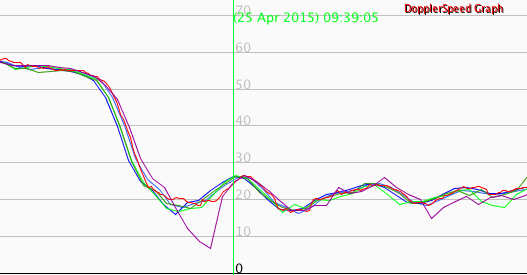
All speed results obtained with the Android phone and GPSLogIt are within 0.6 knots of the numbers the other units gave. The 5x10 second numbers, which are often viewed as the most important top speed numbers, are within 0.1 knots, and well within the accuracy range of the GT-31 and Flysight units. However, the numbers for the nautical mile and especially alpha 500 are significantly lower. A close look at the doppler speed graph and the tracks provides some clues. Let's start with a large-scale view:
Mostly, the data for all 6 units are very close, but there are a few areas in the speed graph where the phone data drop below the other units. Here is a closeup:

There are several short areas in the track where the phone speed is artificially low; this explains why the long distance numbers are a bit lower than for the other units. It is fortunate that the error is on the low side - from the view of a competition, GPS units that understate true speed are acceptable, but units that overstate speed are not.

For the alpha, a look at the tracks when I drove around in circles is illuminating:
Blue: GT-31; red: Flysight; purple: phone & GPSLogIt
The tracks for the Flysight, which uses an UBX GPS chip and records at 5 Hz, is most accurate. The GT-31 tracks are close, but the phone tracks show some obvious deviations. Clearly, the phone had the most problems to accurately track direction changes. This may well be due to processing limitations in the GPS chip firmware that are related to limits on how much battery the GPS chip can drain. As it is, the accuracy is certainly sufficient for the common uses - navigation and photo tagging.

Overall, the GPS accuracy of the phone I used was certainly acceptable, albeit not "perfect". Other phones may use different GPS chips and give different results, but several others have also reported decent accuracy with other phones. Nice to have another option for tracking your windsurfing sessions - and one that's less than $100, even if you buy a phone just for this purpose!

Saturday, April 18, 2015

Three Times Eleven Is Enough

It's getting warm. To warm to stay at home even if the wind is light.
I took the pretty cat out for a ride today. Amazing how the GoPro can make it look small!

A couple of days ago, the lovely Nina joined me for a light wind session. She took the Mistral Pandera and a 5.3 m sail, and had tons of fun in 15 mph wind. I took my BIC wind SUP because I wanted to test my new fin:
It's small - 11 cm, to be exact. When I saw it on the Black Project Fins web site, I just had to have it. Just imagine - put it into the SUP, step a little bit forward, and with a little help from the rocker, I can sail all the way to shore in Hatteras! No more walking!

I figured it would be big enough. When Caesar was here last fall, he never used a fin in light wind. I'm no Caesar. I can sail the SUP without a fin, but need to concentrate so much that I can't do much else. But I have used a 15 cm fin without a problem, so 11 cm should be fine, right?

It took a number of back-and-forth emails to convince Chris at Black Project that I had not lost my mind, but eventually, he mailed me the fin. When I tried it two days ago, I learned stuff. For example, I learned how easy it is to turn a 10 foot 6 board by scissoring your legs when you have a really small fin. It worked, and my previously slow-turning SUP now turned like Nina's Nova.

However, I move a bit slower than Nina, so it turned a tad fast for my taste. Sailing leeside (backwinded) or in switch stance also required just a bit too much attention - not enough pressure on the front foot, and the board turned into the wind.

Then I realized what the problem was: the fin was not too small - it was lonely! There were two unused fin boxes in the board. As soon as I put the two little side fins in there, everything was perfect! All three fins are about the same size, and worked just about 3 times as well as one of them. Surprise! (NOT!!). I have mostly used the board with just one 26 cm center fin in light winds; but 3 times 11 is more than 26! The total area may be a bit smaller, but the board tracked beautifully, even when sailing switch or leeside. Whatever the numbers are - three times eleven is plenty.

Tuesday, April 14, 2015

Kiri Steps Leeside

KUMA Movies  just published another great movie, this one featuring Kiri Thode:

It's a great movie with excellent tricks - the 2013 PWA World Champion in freestyle shows that he is still a serious title contender. Besides the "usual" aerial acrobatic, Kiri also shows some light wind freestyle, including a clew first tack on the rail.

But two other segments caught my attention - here they are:
Twice, Kiri stepped around the mast at full speed before leisurely getting into the foot straps on the lee side and then jumping into a Funnel (to be exact: a Funnel 900 and a Funnel 1620 - that's 4 and 1/2 turns!).

The regular readers of my blog (not you, Jon!) may remember my interest in the Funnel. The usual entry for a Funnel is going switch into the straps while planing, and then ducking the sail. Looks easy and elegant, but is not really easy at all. Walking around the mast sure looks easier!

For once, this is not entirely theory. I have actually played around with the planing backwind jibe during two ABK camps, and found getting onto the other side while planing almost easy. I did not try to get into the straps on the leeside, nor did my backwind jibe attempts succeed, but I got pretty close in fewer than 20 tries. So getting onto the other side and then into the straps appears doable! Whether I will have enough speed left is an entirely different question; even Kiri goes "only" for Funnels, not Burners that require more speed. It may take quite a while before I get to the point where I get into the straps without loosing all speed; but on the way, I may just get the backwind jibe, which is a pretty cool looking move. Stepping around the mast early is also great practice for the planing tack, and my planing tack sure needs some practice!

Let me just point out one big advantage the "step around" approach to getting leeside in the straps has: it works better with larger sails. That's not just what I think, that's what the great Andy Brandt said. So there. When I am comfortable enough to fool around with freestyle, I usually need a 6.0 or 6.5 m sail to get planing; but luffing sails this big from the clew for the duck gets a bit harder. Every once in a while, I may get a perfect day where I can plane on a 5.3, and still feel like doing freestyle. But if it picks up to 4.7 (which means upper 20s for me), forget about it.

Big-sail freestyle; better tacks, cool jibes, Fu's and Switch Konos; and imitating Kiri - what's not to like?